Same Transaction, 14 Different Legal Formats. How We Built One Model to Handle All of Them.
Architecture lessons from five years of Italian fiscal data — and why the normalization problem is harder than the transmission problem
Key Takeaways
- Processing 40 million Italian invoices over five years revealed that semantic interpretation, not format conversion, represents the primary technical challenge in e-invoicing systems.
- Approximately 70% of fiscal documents follow standard patterns while 30% constitute long-tail cases requiring human review and multi-model validation.
- Italian fiscal taxonomy includes 28 document types, 7 VAT nature codes with subcategories, and multiple interconnected reporting streams across different government agencies.
- Threshold-based obligations like Intrastat declarations at €350,000 quarterly intra-EU purchases require intelligence layers that monitor cumulative transaction patterns, not just individual document processing.
- Two invoices with identical XML structure can have completely different fiscal implications based on classification codes, such as N6.1 construction subcontracting versus N6.7 cleaning services.
- Classification accuracy exceeds 95% on standard patterns, but knowing when to surface low-confidence cases for human review proves more valuable than raw accuracy.
- The transmission problem in e-invoicing is largely solved, while the normalization problem—understanding what transactions mean fiscally—remains the unsolved challenge at scale.
Summary
E-invoicing systems face a fundamental challenge that extends beyond format conversion and transmission: the normalization problem. Over five years processing 40 million Italian invoices, analysis reveals that while 70% of documents follow standard patterns that parsers handle easily, the critical challenge lies in semantic interpretation rather than technical transmission. The Italian fiscal system alone requires handling 28 document types, 7 VAT nature codes with subcategories, and multiple reporting obligations that interact across different government systems. Two invoices with identical XML structure can have completely different fiscal implications based on classification fields—for example, VAT nature code N6.1 for construction subcontracting versus N6.7 for cleaning services both appear as reverse charge transactions but require different deductibility treatments and accounting classifications. The normalization problem becomes particularly acute with threshold-based obligations like Intrastat declarations, which trigger at €350,000 in quarterly intra-EU purchases but require monitoring transaction patterns over time rather than individual document processing. Successfully handling this complexity requires moving beyond parser accuracy to intelligent classification systems that understand fiscal semantics, incorporate human feedback loops for the 30% long-tail cases, and maintain awareness of cross-system fiscal obligations that emerge from transaction patterns rather than individual documents.
Same Transaction, 14 Different Legal Formats. How We Built One Model to Handle All of Them.
Architecture lessons from five years of Italian fiscal data — and why the normalization problem is harder than the transmission problem
Paolo Messina | CEO, Mentally Digital LLC — San Jose, California
PhD Physics (EPFL), MBA (Michigan Ross)
Everything was working.
The parser was handling FatturaPA (Italy’s mandatory B2B e-invoicing XML format) correctly. The Sistema di Interscambio (SDI, Italy’s central invoice clearance hub) was accepting every invoice without rejection. The general ledger was updating in real time. VAT was being applied at the correct rate for every transaction type. The Italian subsidiary’s finance team hadn’t received a single error notification in months.
Then, mid-year, one number crossed a threshold.
The company had been expanding its EU supplier relationships — German machinery components, French raw materials, Dutch logistics providers. Gradually, quarterly intra-EU purchase volumes reached €350,000 (~$380,000 USD). At that point, Italian law requires a monthly statistical Intrastat declaration for inbound EU purchases. Not a VAT filing. Not a tax payment. A statistical report to the customs authority — separate from SDI, with different data fields, on a different submission calendar, to a different government agency.
No system flagged it. No ERP workflow was monitoring cumulative cross-border purchase volumes against this threshold. The transmission layer had operated flawlessly for months. The intelligence layer — the one that would have recognized a fiscal obligation accumulating silently from a pattern of transactions over time — didn’t exist.
This is the problem nobody talks about when they talk about e-invoicing. Transmission is solved. Normalization is not.
The Taxonomy Problem
When engineers design e-invoicing systems, they tend to frame the problem as a format conversion challenge. FatturaPA is XML. UBL (Universal Business Language, used across Europe) is XML. XRechnung (Germany’s e-invoicing standard) is XML. Build a parser for each, map the fields, done.
This framing is wrong, and the wrongness becomes visible at scale.
Over five years and 40 million Italian invoices classified in production, we found that the hard problem is not format — it’s semantics. Two invoices with identical XML structure can have completely different fiscal implications depending on a handful of classification fields.
Consider two invoices both marked with VAT nature code N6 — the reverse charge category under Italian VAT law. N6.1 applies to subcontracting in construction. N6.7 applies to cleaning and security services. Both are reverse charge. Both are zero-rated on the invoice. But the deductibility rules, the DSCR (Debt Service Coverage Ratio, a key crisis indicator under Italian law) impact, and the analytical accounting treatment differ. A parser that correctly reads the XML of both invoices has done perhaps 30% of the work. The remaining 70% is knowing what N6.1 means for this company’s cost structure versus what N6.7 means — and applying that interpretation consistently across thousands of documents per month.
Italian fiscal taxonomy as of 2026 includes: 28 document types (TD01 through TD28), 7 VAT nature codes (N1 through N7, each with subcategories), corrispettivi (retail receipts from certified cash registers in a different XML schema entirely), RT (daily receipt aggregations), cross-border e-invoices that must be reported through SDI using specific document codes to indicate they are reporting-only transactions, Intrastat declarations that reference the same underlying transactions but require different data fields, and F24 (Italy’s unified tax payment form) tax payments that are linked to but not contained in any invoice. Each of these streams interacts with the others. The Intrastat threshold problem described above emerged precisely because the invoice stream and the aggregate cross-border purchase calculation lived in separate systems with no layer monitoring their relationship.
The distribution of complexity across a real production dataset is approximately this: 70% of documents fall into roughly 15 standard patterns that a well-designed parser handles without difficulty. The remaining 30% is long tail — partial credit notes referencing partially paid invoices, mixed-rate invoices where different line items carry different VAT codes, split payment transactions for public administration clients, self-billing invoices for certain agricultural and publishing categories, transactions involving non-resident entities that require a specific document type (TD17, TD18, or TD19 depending on the nature of the supply). This long tail is not solvable with a better parser. It is solvable only with a human feedback loop — tax professionals correcting classification errors, those corrections becoming training data, the model improving its handling of edge cases iteratively.
After five years, our classification accuracy on standard patterns exceeds 95%. On long-tail cases, we run multi-model validation and surface low-confidence classifications for human review rather than auto-resolving them. This distinction — knowing when not to be confident — turns out to be more valuable than raw accuracy.
The Canonical Model
The architectural decision that made everything else possible was this: don’t build 14 parsers. Build one canonical fiscal model and 14 connectors.
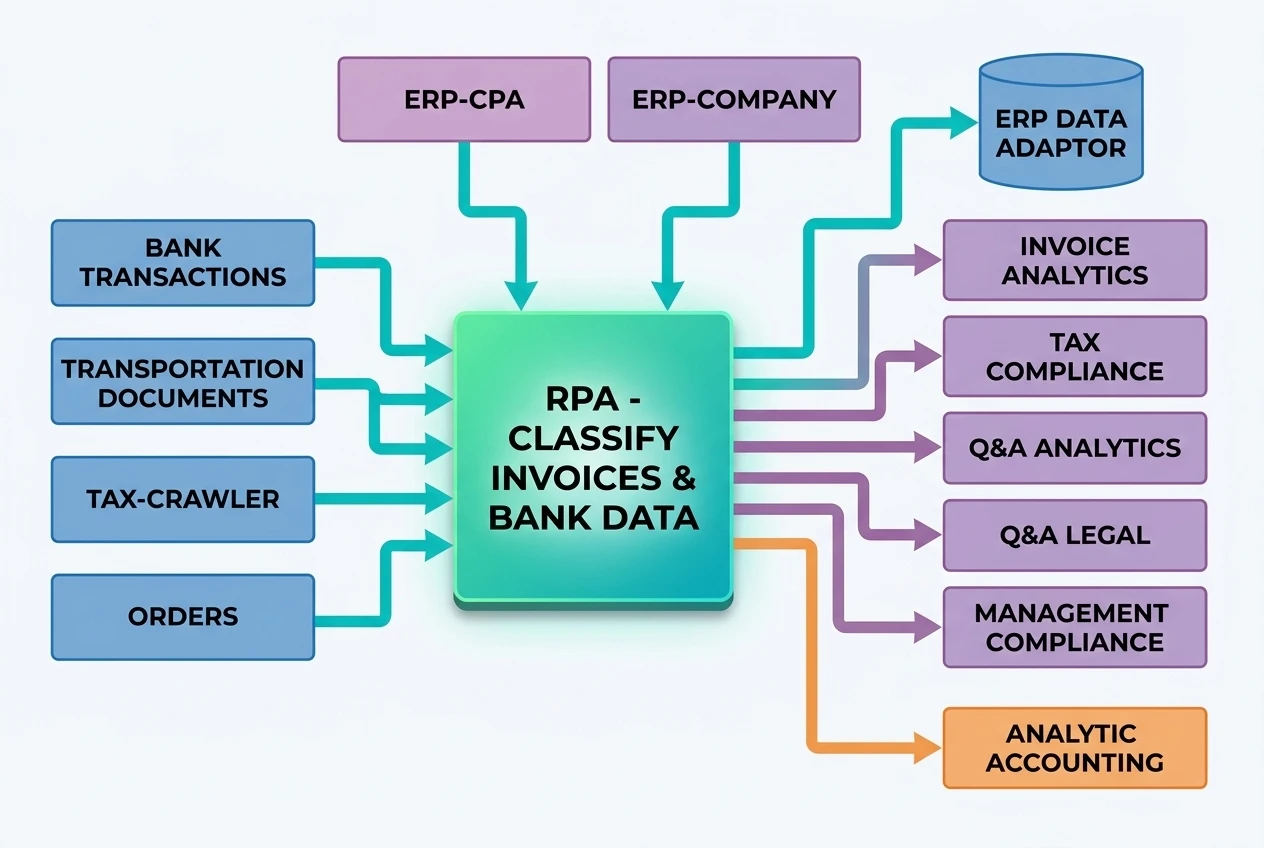
The canonical model has six core entities: company, counterparty, invoice, tax breakdown, payment, and fiscal period. Every fiscal data source — regardless of country, format, or government portal — maps into these six entities. The connectors handle the format-specific parsing. The canonical model handles everything above that layer: classification, reconciliation, analytics, compliance monitoring, Q&A.
The practical consequence: analytical accounting operates on the canonical model, not on the source format. Margins by project or client, fixed versus variable cost structure, break-even calculation, P&L approximation — none of this requires country-specific logic. It works on any structured invoice data that has been normalized into the canonical model. This is why the analytical accounting engine achieves approximately 85% accuracy in real time without ERP integration, regardless of whether the source data is FatturaPA, UBL, XRechnung, or NF-e (Brazil’s electronic invoice system). The remaining 15% — accruals, depreciation schedules, detailed cost center allocation — requires ERP data. When an ERP connects via a bidirectional adaptor, accuracy rises to approximately 98%. But 85% accuracy updated continuously is operationally more useful than 98% accuracy delivered 90 days after the fact for most decisions a CFO or controller actually makes.
The effort to build a new country connector varies significantly based on one dimension: does the country have a modern API, or does it require authenticated portal access?
France (Chorus Pro / Factur-X) and Germany (XRechnung) both conform to EN 16931 — the European e-invoicing standard. Their government portals have modern APIs. Estimated connector effort: 2–4 weeks. Spain (Facturae), Portugal (CIUS-PT via Peppol, the international e-procurement network), and Brazil (NF-e via SEFAZ, the state tax authorities) have web services with structured responses. Moderate complexity. Mexico (CFDI via SAT, the Mexican tax authority) uses a PAC (Authorized Certification Provider) intermediary model — different but API-based.
Italy was structurally different. FatturaPA predates EN 16931 and uses a proprietary XML schema. The Cassetto Fiscale (Italy’s Fiscal Drawer — the government’s fiscal data repository containing the complete fiscal history of every Italian taxpayer) has no API. Access requires PIN authentication to a web portal that was designed for human users, not programmatic access. Building a stable crawler on top of this system took approximately two years — not because the scraping technology was particularly complex, but because the portal changes its layout silently, introduces new document types without announcement, and modifies download paths without versioning. Maintaining the crawler in production requires continuous monitoring and periodic re-stabilization.
This asymmetry — Italy hard, EN 16931 markets much easier — is the correct frame for understanding the global rollout of e-invoicing mandates. Italy proved the model. The markets following Italy in 2026–2030 are structurally simpler to integrate. The canonical model and the intelligence layer built for Italy transfer almost entirely. The connectors are new, but they represent the smaller fraction of the engineering work.
What the Government Portal Data Contains That Invoices Don’t
The canonical model has a second input stream that matters as much as the invoice stream: government portal data.
In Italy, the Cassetto Fiscale contains four categories of data that never transit through SDI: F24 tax payments (the actual amounts paid, by date, by tax type — not the amounts declared), Certificazioni Uniche (CU, annual wage certificates for employees and contractors), declarations filed across all tax types, and enforcement data from Agenzia delle Entrate-Riscossione (the Italian tax collection agency). This data is essential for two capabilities that invoice data alone cannot support.
First, tax compliance monitoring. The difference between taxes declared and taxes actually paid is not visible in any invoice. A company can declare IRES (Italian corporate income tax, equivalent to corporate tax) correctly and pay F24 in installments, partial payments, or with compensation against tax credits. The compliance health score — the metric that tells you whether the company’s actual tax behavior matches its declared position — requires the F24 payment stream. Without it, you can verify that the invoices are correct. You cannot verify that the obligations derived from those invoices were actually settled.
Second, crisis indicator monitoring. The D.Lgs 14/2019 framework (Italy’s business crisis early warning law, equivalent to the UK’s insolvency prevention requirements) requires monitoring 13 KPIs including the DSCR. Several of these KPIs are only calculable when you have both the invoice data (for revenue and cost flows) and the F24 payment data (for actual tax obligations). Compliance with adeguati assetti (adequate organizational arrangements, a requirement under Italian corporate law for companies to maintain systems for crisis detection) depends on this combined dataset. 96.5% of Italian SMBs are currently non-compliant with this requirement. The primary reason is that no standard accounting system pulls both data streams and computes the required indicators automatically.
Multi-Model Routing and the Q&A Layer
When the canonical model is populated — invoices classified, bank transactions reconciled, government portal data integrated — the next engineering challenge is making the data queryable by non-technical users.
Natural language Q&A on fiscal data sounds like a standard RAG (Retrieval-Augmented Generation) problem. It isn’t.
The difficulty is that fiscal questions are precise and fiscal terminology is ambiguous. A CFO asking “what were our transport costs last quarter” may mean: invoices with supplier ATECO codes (Italy’s industry classification system, similar to NAICS codes) in the transport sector, or invoices with the service description containing transport-related terms, or invoices classified under specific cost center codes, or some combination. The answer differs by €40,000 (~$43,000 USD) depending on interpretation. A general-purpose LLM will pick one interpretation and return a confident answer. In a fiscal context, a confident wrong answer is worse than no answer.
Our approach uses multi-model routing: three or more LLMs process the question in parallel, each with the same context about the canonical model’s structure. A disambiguation layer identifies where the models disagree — this disagreement is the signal that the question is ambiguous. Instead of arbitrating between models, we surface the ambiguity to the user: “This could mean X (€380,000) or Y (€340,000) — which interpretation did you intend?” The user’s clarification then becomes a resolved query that returns a verified number from the structured database, not a generated approximation.
The verification step is non-negotiable. Every answer to a fiscal Q&A query is cross-referenced against the underlying structured data before delivery. The response format is always: natural language explanation + the data point extracted from the canonical model + the source documents that support it. This means the CFO can audit any answer by tracing it back to the specific invoices, bank transactions, or government portal records that generated it. In a tax context, auditability is not a nice-to-have. It’s the condition under which the output is usable at all.
What Remains Unsolved
Intellectual honesty requires naming the parts that are not yet solved.
Long-tail classification in new markets requires local production data. The training corpus for Italian fiscal taxonomy took five years to build, with continuous corrections from 70+ commercialista (Italian CPA and business advisor) firms. Entering France in September 2026 means building a new corpus from scratch for French fiscal taxonomy — a different set of VAT codes, different document types, different treatment of intra-community supplies under French implementation of ViDA rules (the EU’s VAT in the Digital Age directive). The canonical model transfers. The classification accuracy does not, until the training data exists.
Legal RAG — retrieval-augmented generation over tax legislation and case law — requires a local legal corpus for each jurisdiction. Italian legal RAG covers the TUIR (Testo Unico delle Imposte sui Redditi, Italy’s consolidated income tax act), the IVA decree (Italy’s VAT law), D.Lgs 14/2019, circulars from the Agenzia delle Entrate (Italian Revenue Agency, equivalent to IRS), and relevant case law from the Corte di Cassazione (Italy’s Supreme Court). Each of these sources has different update frequencies, different authority levels, and different relationships to the canonical model’s classification logic. Building the equivalent for France or Germany requires 8+ weeks of corpus construction and validation per country — significantly more than the 2–4 weeks required for a format connector.
The feedback loop dependency. The human correction mechanism — tax professionals flagging classification errors, those corrections updating the model — is the component that makes production accuracy possible. It is also the component that cannot be replaced by synthetic data generation or zero-shot prompting. In markets where we don’t yet have a network of local practitioners reviewing outputs, production accuracy starts lower and improves more slowly. This is a distribution problem as much as a technical one.
The Architecture Bet
The core architectural bet behind everything described here is this: the intelligence layer — classification, reconciliation, analytics, compliance monitoring, Q&A — should be independent of the transmission layer. Transmission platforms connect companies to government portals and handle format compliance. The intelligence layer sits on top, operating on normalized data regardless of where it came from.
This separation matters for two reasons. First, it makes the intelligence layer extensible without re-architecting the transmission layer. Second, it means the intelligence layer can operate on data from multiple sources simultaneously — SDI invoices, bank transactions, government portal data, ERP feeds — and produce a unified analytical output that no single-source system can match.
Italy was the test case. The mandates arriving in 2026–2030 are the scale case.
The companies building the intelligence layer now will have five years of production data — classified, corrected, and validated by real finance professionals — by the time ViDA’s Digital Reporting Requirements become mandatory across the EU. The companies that wait will be building from zero in a market where structured fiscal data is no longer a differentiated asset, because everyone will have it.
The transmission problem is solved. The normalization problem is where the next five years will be decided.
Paolo Messina is CEO of Mentally Digital, an AI fiscal intelligence engine in production with 70+ Italian commercialista firms and 40M+ classified invoices. The platform is built on a country-agnostic canonical fiscal model with country-specific connectors for Italy, with France, Germany, and Spain in development.
Live production demo with real Italian fiscal data: https://saluteimpresa.mentally.ai/en/tax-demo
For architecture discussions: info@mentally.ai
Data and Statistics
40M+
14
95%+
70%
30%
€350K
28
6
Frequently Asked Questions
- What is FatturaPA and why is it mandatory in Italy?
- FatturaPA is Italy's mandatory B2B electronic invoicing format, using a proprietary XML schema that predates the EU standard EN 16931. It is legally required for all B2B transactions in both public and private sectors, and increasingly for some B2C transactions as of 2024. All FatturaPA invoices must be validated and routed through the Sistema di Interscambio (SDI), Italy's central invoice clearance hub. Companies selling to Italian public administration cannot be paid without compliant FatturaPA format. The format includes specific tax codes, payment method codes, and regulatory references that traditional international accounting systems often fail to validate properly.
- How does Mentally.ai's model handle all 14 Italian invoice formats with one system?
- Mentally.ai built a single multi-task learning architecture with format-specific attention heads rather than 14 separate models. The system uses a four-step process: format identification (analyzing document structure, XML schemas, PDF layouts, and linguistic patterns), format-specific validation (applying exact regulatory rulesets based on classification), contextual extraction (adapting data extraction to format requirements like CIG codes for public procurement), and cross-format normalization (translating all formats into a unified internal representation). This approach achieves 99.7%+ precision on critical fields by separating a stable core model from an updateable rule layer that adapts to regulatory changes without retraining.
- Do international accounting platforms like Xero or QuickBooks handle Italian invoice complexity?
- Major international accounting platforms (Xero, QuickBooks, NetSuite) have basic Italian localization but rarely validate across all 14 format variations or integrate with required Italian systems like Sistema Tessera Sanitaria for healthcare providers. They typically handle standard B2B formats but often fail on reverse-charge, split-payment, or sector-specific scenarios. Foreign companies should budget €200-800 monthly for specialized Italian automation tooling, which is vastly lower than the cost of Agenzia delle Entrate penalties, commercialista time fixing errors, or delayed vendor payments due to format issues. Any automation tool should provide format classification transparency showing which of the 14 formats it detected and why.
- What is a CIG code and when is it required on Italian invoices?
- CIG (Codice Identificativo Gara) is a mandatory reference number required on invoices for public procurement contracts in Italy. It identifies the specific tender or procurement procedure. CIG codes matter only for public administration invoices (B2G transactions), not for standard B2B or B2C invoices. Missing a CIG code on an invoice to an Italian government entity will cause rejection by the Sistema di Interscambio (SDI). Format-aware classification systems must know when to require CIG codes based on the customer type and transaction classification, demonstrating why invoice processing in Italy requires contextual validation beyond simple data extraction.
- Why does Italy have 14 different invoice formats for the same transaction?
- Italy requires 14 different invoice formats due to layered Italian tax law, EU directives, and sector-specific regulations. The format variation depends on transaction type (B2B domestic, B2B cross-border, B2C, B2G), tax treatment (standard VAT, reverse charge, split payment, exempt), sector regulations (healthcare providers must use Sistema Tessera Sanitaria, public administration requires specific FatturaPA codes), legal entity status (simplified regime vs ordinary taxation), and document purpose (invoices, credit notes, advance payments, self-billing). Each format has distinct regulatory requirements, data fields, and validation rules that carry legal meaning beyond simple data extraction.
- What penalties do foreign companies face for incorrect Italian invoice formatting?
- Foreign companies operating in Italy face Agenzia delle Entrate (Italian Revenue Agency) penalties starting at €250 per violation for format-noncompliant invoices, multiplied by the number of incorrect invoices. For missing split payment declarations, penalties range from €250 to €2,000 per violation. In severe cases involving tax evasion, Italy can fine up to 180% of evaded tax. These penalties apply whether you're an Italian subsidiary of a foreign company, a supplier to Italian businesses, or a service provider to Italian clients. Non-compliant invoices also create uncertain tax liabilities that can delay acquisitions during due diligence.
- What is split payment (scissione dei pagamenti) in Italian invoicing?
- Split payment (scissione dei pagamenti) is an Italian mechanism where the customer pays VAT directly to tax authorities instead of to the supplier. It applies specifically to certain B2G (business-to-government) transactions, particularly invoices to public administration entities like ministries or universities. The invoice must include a specific split payment flag and use correct tax codes. Missing this declaration can result in penalties of €250-2,000 per violation. Split payment invoices require different validation rules than standard B2B invoices, and the VAT treatment affects both cash flow and accounting reconciliation processes.
- How often does Italy update its FatturaPA specifications and validation rules?
- Italy updates FatturaPA specifications and tax codes multiple times yearly. For example, version 1.7.1 was released in 2023, adding new payment method codes. Italy is also progressively mandating FatturaPA for more transaction types, with some B2C transactions requiring structured electronic formats as of 2024. Upcoming EU ViDA (VAT in the Digital Age) reforms will require Italy to reconcile its domestic FatturaPA system with new EU-wide e-invoicing standards, likely creating hybrid format requirements. These frequent changes mean hardcoded validation rules in traditional automation systems break regularly, requiring architecture that separates stable core models from updateable rule layers.
- What is the regime forfettario and how does it affect Italian invoice formats?
- Regime forfettario is Italy's flat-rate tax regime for small businesses, creating specific invoice format requirements different from ordinary taxation. Small businesses under this simplified regime issue invoices with different VAT treatment, tax code references, and regulatory declarations than companies under ordinary taxation. The same €10,000 service delivery might require completely different formatting, validation rules, and compliance checks depending on whether the supplier operates under regime forfettario or standard taxation. This legal entity status distinction is one of the five main factors that drive format variation in Italian invoicing, alongside transaction type, tax treatment, sector regulations, and document purpose.