CFO Guide Italy: Mentally vs Check-up Impresa 2025
Compare Mentally Copilot with Check-up Impresa and Digital CFO for 2025. Learn about certified compliance and AI predictive intelligence for CFOs.

Key Takeaways
- TeamSystem's Check-up Impresa offers MORE-certified rating by ModeFinance, recognized by Banca d'Italia (Bank of Italy, the Italian central bank) and ESMA (European Securities and Markets Authority), used by credit institutions to assess the creditworthiness of Italian SMEs.
- Digital CFO by Zucchetti builds dashboards based on quarterly financial statements validated by the collegio sindacale (Italian statutory board of auditors, a mandatory supervisory body for certain company types), ensuring certified accuracy but requiring technical accounting close timelines for each update.
- Mentally Copilot uses machine learning for continuous real-time financial forecasting, enabling immediate what-if scenario simulations without waiting for quarterly or semi-annual accounting closings.
- Article 2086 of the Italian Civil Code, as amended by Legislative Decree 83/2022, requires directors of Italian SMEs to establish adeguati assetti organizzativi (adequate organizational, administrative, and accounting arrangements). This reform mandates certified compliance tools to meet the new legal standard. Under Italian law, company directors now face personal liability if they fail to implement these organizational frameworks. This means foreign companies operating Italian subsidiaries or branches must ensure their local management has proper systems in place—not just for tax compliance, but for corporate governance that meets Italy's updated Corporate Code requirements. The practical implication for international businesses: Italian operations now require documented internal controls, risk monitoring systems, and formalized decision-making processes. Many foreign companies work with a commercialista (Italian CPA and business advisor) to implement compliant frameworks that satisfy both Italian regulators and parent company audit requirements.
- # CFOs at companies with €10-100 million (~$11-110 million USD) in revenue and commercialisti (Italian CPAs and business advisors) offering fractional CFO services to 15-30 clients need both backward-looking quarterly compliance and continuous forward-looking predictive intelligence. CFOs at mid-market companies generating €10-100 million (~$11-110 million USD) in annual revenue face a dual mandate: ensuring quarterly compliance with Italian regulatory requirements while simultaneously maintaining real-time strategic visibility into future financial performance. This same challenge applies to commercialisti (Italian CPAs and business advisors) who provide fractional CFO services across portfolios of 15-30 clients—they must deliver both retrospective compliance accuracy and forward-looking business intelligence at scale. **Backward-looking compliance** involves quarterly reporting obligations to the Agenzia delle Entrate (Italian Revenue Agency, equivalent to IRS), VAT reconciliation through FatturaPA (Italy's mandatory B2B e-invoicing system), preparation of financial statements under Italian GAAP, and documentation required for regulatory audits. These tasks are non-negotiable, time-sensitive, and carry significant penalties for errors or delays. **Forward-looking predictive intelligence** means continuous cash flow forecasting, scenario modeling for strategic decisions, early warning systems for liquidity risks, profitability analysis by business unit or client, and KPI dashboards that inform operational adjustments before problems materialize. This intelligence enables CFOs and their commercialisti advisors to shift from reactive firefighting to proactive strategic partnership with company leadership. The tension between these two requirements creates operational strain: compliance work consumes the majority of available time and resources, leaving limited capacity for the strategic analysis that actually drives business value. For commercialisti managing fractional CFO relationships across 15-30 clients, this challenge multiplies—each client demands both compliance precision and strategic insight, but traditional workflows force an either/or trade-off. Modern AI accounting automation platforms address this dual mandate by automating compliance workflows (including FatturaPA processing, VAT reconciliation, and regulatory reporting preparation) while simultaneously generating real-time predictive analytics from the same underlying financial data. This enables CFOs and commercialisti to meet all backward-looking obligations while dedicating strategic capacity to forward-looking intelligence that differentiates their advisory value.
- TeamSystem serves over 700,000 clients with 1,400 employees and a network of 600 distribution partners, representing Italy's established leader in business management software with 40 years of experience.
- # Complete Coverage for Modern Italian SME CFOs: Combining Compliance and Predictive Intelligence The combination of Check-up Impresa or Digital CFO for regulatory compliance with Mentally Copilot for predictive intelligence offers complete coverage of the needs of modern CFOs in Italian SMEs (small and medium-sized enterprises).
Summary
In 2025, Italian CFO software divides into three distinct platforms serving different needs: Mentally Copilot, Check-up Impresa, and Digital CFO. Mentally Copilot is an AI-powered financial intelligence platform that provides real-time conversational access to Italian accounting data, with pricing starting at €200-500 monthly and deployment in days rather than months. Check-up Impresa, developed by TeamSystem with ModeFinance, serves as the established standard for Italian regulatory compliance and CNDCEC indices monitoring, with fixed monthly fees ranging €100-400 for SME deployments. Digital CFO offers comprehensive integrated accounting, treasury, and planning functionality, requiring €400-1,200+ monthly and 2-4 month implementation timelines. The critical distinction is that Mentally Copilot augments existing commercialista relationships and accounting systems without replacement, while Digital CFO requires complete system migration and commercialista platform adoption. For foreign companies operating in Italy, the choice depends on whether they need strategic intelligence without disruption (Mentally Copilot), standardized compliance reporting (Check-up Impresa), or comprehensive platform transformation (Digital CFO). All three platforms must integrate with Italy's unique requirements including FatturaPA mandatory e-invoicing, Agenzia delle Entrate tax reporting, and the commercialista advisory relationship that combines tax advisor, accountant, and strategic consultant roles essential to Italian corporate compliance.
Mentally Copilot vs Check-up Impresa and Digital CFO: Which CFO Software in 2025?
Complete Technical Comparison: Predictive Intelligence vs Regulatory Compliance for Italian SMEs
Who This Comparison Is For
This article serves three categories of professionals managing the economic and financial health of Italian SMEs:
1. Internal CFOs and Controllers at companies with €10-100M revenue who must balance daily management control, strategic board reporting, continuous predictive forecasting, and regulatory compliance on adeguati assetti organizzativi (adequate organizational arrangements, per Italian Corporate Code).
2. Commercialisti (Italian CPAs and business advisors) providing fractional CFO services to 15-30 SME clients, delivering not just tax compliance but also strategic consulting, rapid what-if scenarios, predictive liquidity analysis, and real-time performance monitoring.
3. Corporate crisis specialists supporting distressed companies in composizione negoziata (Italian pre-insolvency negotiated settlement procedure), debt restructuring, and turnaround, requiring operational predictive tools beyond regulatory ones to identify problems in advance.
If you’re evaluating Check-up Impresa (TeamSystem), Digital CFO (Zucchetti), or Mentally Copilot for yourself or your clients, keep reading. You’ll discover they’re not direct competitors: they answer different questions and, in many cases, work better combined.
The Problem: Two Fundamental Questions
Before comparing solutions, let’s clarify the context. Italian CFOs and commercialisti must answer two fundamentally different questions requiring different tools:
Question 1: “Are We Compliant?” (Backward-Looking Compliance)
“Has management established adeguati assetti organizzativi as required by Article 2086 of the Italian Civil Code? Are CNDCEC (Italian CPA Council) indices within limits? Is our bank rating sufficient to renew credit lines? Do we have documentation ready for composizione negoziata if necessary?”
This is PAST/PRESENT looking:
You analyze closed financial statements, calculate indices on actual data, certify that current situation meets regulatory parameters. Essential to avoid unlimited personal liability for directors and maintain banking relationships.
Consequences of non-compliance:
- Administrative sanctions and personal asset liability for directors
- Loss of access to bank credit lines and Fondo Garanzia PMI (Italian State SME Guarantee Fund)
- Inability to access composizione negoziata
- Disputes with auditors/board of statutory auditors
Required frequency: Quarterly/semi-annual (interim financials) + annual (closed statements)
Question 2: “What Will Happen?” (Forward-Looking Strategy)
“If revenue drops 15% in Q4 due to losing a major client, what’s the impact on IRES (Italian corporate income tax), 6-month liquidity, ability to service loan payments? If all customers shift payment terms from 60 to 90 days, when do we hit overdraft? What corrective actions are needed NOW to avoid crisis in 3-6 months?”
This is FUTURE looking:
You predict scenarios, simulate what-ifs, identify problems BEFORE they appear in actual financial statements. Essential for rapid strategic decisions (new investments, hiring, debt renegotiation, securing liquidity).
Consequences of validated-financials-only approach:
- Dashboards built on quarterly closed statements certified by board of statutory auditors (validation process ensuring maximum accuracy but naturally requiring technical closing time)
- Inability to answer board questions in real-time on unforeseen what-if scenarios
- Delayed identification of emerging negative trends between statement closings
- Strategic decisions based on validated periodic snapshot rather than continuous monitoring
Required frequency: Continuous/real-time (weekly/monthly decisions)
Reality: You need BOTH answers. But they require different software categories.

Three Approaches: Established Leaders vs New Category
Check-up Impresa (TeamSystem): The Standard for Certified Compliance
TeamSystem is the Italian leader in business software with over 700,000 clients, 1,400+ employees, 40+ years experience, and nationwide presence through a network of 600+ partner distributors. Check-up Impresa, developed in collaboration with ModeFinance (rating agency certified by Banca d’Italia and authorized by ESMA - European Securities and Markets Authority), represents the established market standard for complying with Codice della Crisi d’Impresa (Italian Corporate Crisis Code - Legislative Decree 14/2019) and the obligation of adeguati assetti organizzativi (Article 2086 Civil Code modified by Legislative Decree 83/2022).
Where it excels - Certified Regulatory Compliance:
Institutional ratings with legal value:
-
MORE Rating (ModeFinance): 0-100 credit score recognized by Italian and European credit institutions for creditworthiness assessment. Based on proprietary algorithm analyzing 14 areas (profitability, solidity, liquidity, operational efficiency, competitive position). Updated quarterly, includes 12-month default probability and sector benchmark on 200+ comparables. Banks accept it for credit line/loan processing without requiring additional internal analysis.
-
MCC Rating (Mediocredito Centrale - Italian State Development Bank): Mandatory certification for accessing Fondo di Garanzia PMI (Italian State SME Guarantee Fund). Check-up automatically calculates score according to official Mediocredito methodology, verifies size requirements (revenue <€50M, employees <250), simulates obtainable guarantee percentage (50%-90% depending on risk class). Without positive MCC rating, impossible to obtain state guarantee on financing.
Official CNDCEC indices validated:
Automatic calculation of three mandatory indices according to Consiglio Nazionale Dottori Commercialisti (Italian National CPA Council) guidelines (January 2024 updated version):
-
Negative Equity: Verifies if Equity < 0 (immediate alert signal per Article 13 Crisis Code). System calculates equity from reclassified balance sheet according to civil code schema, applies adjustments (non-distributable reserves, carried forward profits/losses), generates red alert if negative.
-
DSCR - Debt Service Coverage Ratio (6 and 12 months): Measures debt service capacity. Formula: (EBITDA - Working Capital Change - Taxes) / (Principal Repayments + Interest Expenses). DSCR < 1 = inability to repay debts with operating flows. Check-up calculates both 6-month and 12-month prospective, compares with CNDCEC sector threshold (varies from 1.0 to 1.3 depending on ATECO sector code).
-
Sector-specific indices: Depending on ATECO code, adds relevant indices (e.g., Return on Invested Capital for manufacturing, Inventory Turnover Index for retail, DSO for services). Automatic comparison with Cerved (Italian credit bureau) sector medians on sample of 50,000+ Italian companies.
Centrale Rischi Banca d’Italia (Italian Central Credit Register) - Complete Analysis:
Automatic import of CR report (.xml file from BankItalia portal), automatic parsing of sections:
- Census: All open banking relationships (current accounts, loans, leasing, invoice advance)
- Self-liquidating vs term risks: Distinction between invoice advance (automatically close with collection) vs loans (require active repayments)
- Bad debts and watchlist: Identifies relationships with disputes, delays >90 days, credit line revocations
- Credit line utilization: Calculates % utilization per bank (e.g., €100K limit, €85K used = 85% utilization). Alert if >80% (financial tension signal for banks).
Deep TeamSystem ecosystem integration:
If company/firm uses TeamSystem Contabilità, TeamSystem Azienda, TeamSystem Studio, TeamSystem Fatturazione Elettronica (TeamSystem suite products): financial data flows automatically every night without manual export/import. System connects via internal TeamSystem APIs, retrieves EU balance sheet, accounting situation, customer/supplier subledgers, payment schedule, VAT journal. Over 100 TeamSystem products integrable.
Compliance reporting with legal value:
PDF reports with:
- Certified digital signature and certain date (legal value for court)
- Adeguati assetti organizzativi attestation signable by director
- Documentation for board of statutory auditors on going concern (ISA 570 - International Standard on Auditing)
- Rating report for banks (ABI - Italian Banking Association standard format)
- Checklist for independent expert in composizione negoziata
ESG Advanced Module (optional):
Sustainability analysis according to GRI (Global Reporting Initiative) and SASB (Sustainability Accounting Standards Board) frameworks. Increasingly required by: banks for sustainable financing (linked loans with reduced rate if you reach ESG targets), large customers (requirement to enter corporate supply chain), PNRR (Italian Recovery Plan) public tenders (bonus for certified sustainable companies).
Ideal for:
- Commercialisti who must certify regulatory compliance for portfolio of 50-200 clients
- Companies in continuous relationship with banks for credit lines and financing
- Statutory auditors assessing going concern and business continuity
- Firms with clients already on TeamSystem ecosystem (data already digital)
Pricing: Upon commercial request. TeamSystem adopts enterprise model with customized quotes based on: number of companies monitored simultaneously, activated modules (Light base / PRO advanced / ESG sustainability), integration level with other TeamSystem products, presence/absence of on-site training support.
Digital CFO (Zucchetti): Composizione Negoziata Specialist with AI
Zucchetti is the first Italian software group by revenue in Europe according to IDC, with over 8,000 employees, 1,700 different solutions, €1.5 billion consolidated revenue, and presence in 60 countries. Digital CFO is developed by GhostCFO srl (Zucchetti group controlled company) specifically to support composizione negoziata della crisi d’impresa (Italian pre-insolvency negotiated settlement - Decree-Law 118/2021 converted into Law 147/2021) and crisis situation prevention according to Crisis Code.
Where it excels - Procedural Crisis Management:
Complete guided composizione negoziata procedure:
Only Italian market software with integrated step-by-step workflow for composizione negoziata:
-
Preliminary access test: Verifies Article 12 Crisis Code requirements (company not bankrupt, no liquidation, no ongoing concordato preventivo - Italian composition with creditors). Automatic 15-question questionnaire on: debt situation, financial tensions, bank/supplier disputes.
-
Automatic chamber indicator calculation: Formula provided by MISE Decree (Italian Ministry of Economic Development): compares company indices (DSCR, ROE, equity/debts, liquidity) vs sector medians. 0-100 score: if <40 = almost certain access, 40-60 = case-by-case evaluation, >60 = difficult access. Digital CFO calculates automatically, explains which indices penalize.
-
Chamber test simulation: Before submitting formal application, simulates if Camera di Commercio (Italian Chamber of Commerce) will accept. Avoids “burning” composizione opportunity with premature rejected application.
-
Documentation checklist for independent expert: Generates list of 40+ documents to prepare for expert appointed by Chamber of Commerce: last 3 financial statements, updated accounting situation, supplier payment schedule, bank statements last 12 months, CR report, dispute list, preliminary recovery plan.
-
6-month treasury budget for recovery plan: Precompiled template with: expected collections (issued invoices not collected + new orders), expected payments (overdue suppliers + new supplies + salaries + loan installments + taxes), daily progressive balance. Identifies when additional liquidity needed.
-
Real-time sharing platform with expert: Cloud workspace where Chamber expert, entrepreneur, commercialista collaborate on same document. Expert sees real-time data, asks questions, entrepreneur responds, commercialista updates. No disorganized email/WhatsApp exchanges.
AI for intelligent Centrale Rischi suggestions:
Zucchetti proprietary artificial intelligence analyzes CR report and generates actionable suggestions:
- “Bank X revoked €50K credit line on 09/15. Suggestion: contact bank immediately, present repayment plan, avoid them reporting bad debt which propagates to other banks”
- “Average credit line utilization 92% (vs 75% prudential limit). Risk: next utilization increase triggers automatic revocation. Action: request credit line increase OR reduce utilization by paying suppliers with deferred terms instead of invoice advance”
- “You have 3 banks, 80% concentration on Bank Y. Risk: if Y closes relationship, immediate liquidity crisis. Diversify by opening relationship with Bank Z”
Integrated certified digital signature:
All reports generated by Digital CFO include:
- Qualified electronic signature according to eIDAS (EU Regulation 910/2014)
- Timestamp with certain date opposable to third parties
- Immediate legal value for: bankruptcy court, Camera di Commercio, Agenzia delle Entrate (Italian Revenue Agency), credit institutions
- No external passage (like Aruba, Infocert providers) to certify documents
Structured certified training:
Partnership with ANDOC (Italian CPA Association), UNGDCEC (Young Italian CPAs Union) for accredited courses:
- Course A - Corporate crisis regulations (4 hours, €220): Crisis Code, composizione negoziata, Chamber role, directors’ liability
- Course B - Adeguati assetti + practical test (4 hours, €220): Article 2086 Civil Code, arrangements implementation, self-assessment questionnaire, case studies
- Course C - Rating, KPIs, Centrale Rischi (4 hours, €220): CR interpretation, rating improvement, advanced financial KPIs
Professional training credits recognized by CNDCEC.
Zucchetti ecosystem integration:
If firm/company uses Zucchetti Contabilità, Zucchetti Paghe (Payroll), Zucchetti Fatturazione: automatic data import without intermediate Excel files. Connection via Zucchetti Cloud APIs, nightly synchronization of financial statements, schedules, F24 (Italian unified tax payment form).
Ideal for:
- Corporate crisis consultants following 10-30 distressed companies
- Commercialisti supporting clients in composizione negoziata (entrepreneur fiduciary role)
- Companies wanting continuous preventive monitoring of alert signals to intervene BEFORE crisis
- Firms with clients on Zucchetti ecosystem (data already available)
Transparent public pricing:
€990/year for first company + €600/year for each additional company beyond first. Optional training via certified courses: €220 per single course, €600 three-course package. Free 30-day trial with promoter code from authorized Zucchetti reseller.
Example firm costs:
- 5 clients: €990 + (4 × €600) = €3,390/year
- 15 clients: €990 + (14 × €600) = €9,390/year
- 30 clients: €990 + (29 × €600) = €18,390/year
Mentally Copilot: Forward-Looking Predictive Intelligence for Rapid Strategic Decisions
Mentally is an Italian company (Delaware LLC with distributed team Italy/Ukraine/Vietnam, legal headquarters San Francisco for access to US venture capital market) in growth phase with 250-300 active clients among Italian CPA firms and manufacturing/service SMEs, focused exclusively on forward-looking predictive artificial intelligence and daily operational automation, not certified regulatory compliance.
Fundamental philosophical difference:
While TeamSystem Check-up and Zucchetti Digital CFO answer the question “Are we compliant looking at past financial statements?”, Mentally answers “What will happen in the next 3-6 months and what decisions to take NOW?”. They’re not competitors: they answer different questions.
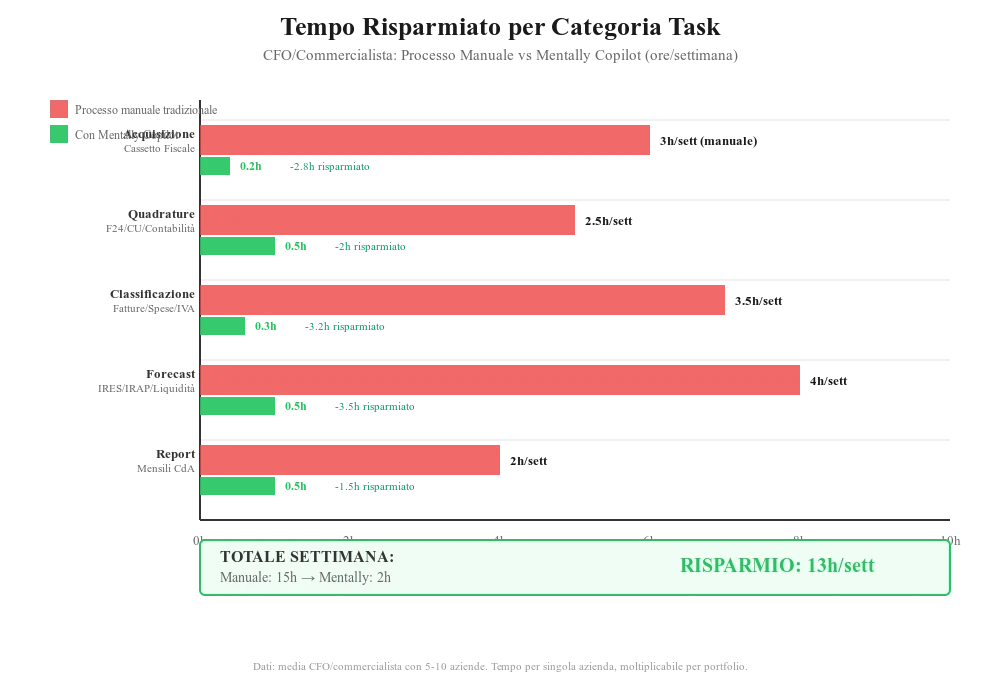
Where it excels - PART 1: FORWARD-LOOKING PREDICTIVE (Primary Differentiator)
#1 - Conversational AI Tax Forecasting Multi-Scenario Instant
Detailed traditional problem:
CFO must prepare Q4 IRES/IRAP (Italian corporate and regional production taxes) forecast for board. Manual Excel process:
- Download updated accounting situation from ERP (10-15 minutes)
- Copy revenues/costs to proprietary Excel forecast template (15-20 minutes)
- Calculate IRES taxable income: Revenues - Deductible costs - Depreciation - TFR provisions (Italian severance pay) - Bad debt write-offs (25-30 minutes, risk of formula errors)
- Apply upward variations (windfalls, non-deductible car costs >€25K, penalties, donations)
- Apply downward variations (ACE deduction - Italian notional interest deduction on equity, super-depreciation on capital goods, R&D credits)
- Calculate IRES 24% on final taxable (5 minutes)
- Calculate IRAP taxable base: Production value - Deductible costs (WITHOUT employee labor cost, this is the critical difference with IRES) (15 minutes)
- Apply regional IRAP deductions: employee labor tax wedge, interest on mortgage loans (10 minutes)
- Apply regional IRAP rate (varies: 3.9% Lombardy, 4.97% Lazio, 3.3% special regions)
- Total time: 2.5-3 hours for ONE scenario
If CEO during board asks “redo with -15% revenue instead of -10%”, you must redo everything from scratch. If you want 3 scenarios (best/base/worst case): 2.5h × 3 = 7.5 hours work.
Detailed Mentally solution:
Conversational AI system based on multi-LLM architecture:
Natural language input (no forms, no menus):
Open chat, write: “Forecast Q4 2025 IRES and IRAP assuming: revenue -15% vs Q3, fixed costs unchanged, customer payment terms from 60 to 90 days, no new hiring, asset X sale with €25K capital gain”
AI semantic parsing:
7 integrated LLMs (Gemini, Claude, GPT-4, DeepSeek, Qwen, Kim2, Llama) - system automatically chooses best for task - extract parameters:
- Revenue: -15% vs Q3
- Fixed costs: unchanged (no growth)
- Working capital: +30 day customer terms (worsens liquidity)
- Personnel: stable (no new INPS - Italian social security contributions)
- Extraordinary events: €25K capital gain (IRES taxable, not IRAP)
Automatic real-time calculation:
System takes updated data from:
- AdE tax portal (Agenzia delle Entrate): Electronic invoices issued last 90 days (real revenue trend)
- TeamSystem ERP: Accounting situation as of yesterday (incurred costs, accrued depreciation)
- Customer schedule: DSO (Days Sales Outstanding) current 68 days, projection to 90 days
- Asset register: Asset X book value €180K, sale value €205K, capital gain €25K
Applies:
- Q4 revenue projection: Q3 revenue €850K × 0.85 (−15%) = €722K
- Variable costs: Raw materials 40% revenue = €289K
- Fixed costs: Personnel €180K, Rent €35K, Utilities €12K = €227K
- Q4 EBITDA: €722K - €289K - €227K = €206K
- Depreciation: €45K (from automatic plan)
- EBIT: €206K - €45K = €161K
- Asset capital gain: +€25K
- IRES taxable income: €186K
- Tax variations: Non-deductible car costs €8K, ACE deduction €12K = Net +€8K -€12K = -€4K
- Final IRES taxable: €182K
- IRES due: €182K × 24% = €43,680
- IRAP taxable base: Production value €722K - Costs (excluding personnel) €336K = €386K
- Employee labor tax wedge deduction: €180K × 70% = €126K (IRAP deductible)
- IRAP taxable: €260K
- IRAP due Lombardy: €260K × 3.9% = €10,140
Structured output in 30-40 seconds:
Q4 2025 TAX FORECAST
Scenario: -15% Revenue, +30d Terms, Asset X Sale

IRES:
- Taxable income: €182,000
- IRES 24%: €43,680
- Due date: November 30, 2025 (December advance)

IRAP Lombardy:
- Taxable base: €260,000
- IRAP 3.9%: €10,140
- Due date: November 30, 2025

TOTAL Q4 TAXES: €53,820

CASH FLOW IMPACT:
- €53,820 outflow by 11/30
- With customer +30d terms: €120K collections delayed from Nov to Jan
- Available liquidity today: €85K (from account balance + available credit line)
- LIQUIDITY GAP: -€88,820 (overdraft risk)

SUGGESTED CORRECTIVE ACTIONS:
1. Advance Oct/Nov invoice collection with 2% early payment discount
2. Request IRES/IRAP payment deferral (installment up to 20 payments)
3. Consider commercial credit assignment (pro-soluto factoring)
Instant parallel multiple scenarios:
Ask: “Generate 5 scenarios with revenue: -5%, -10%, -15%, -20%, -25%”
AI calculates all 5 simultaneously (not sequential), presents comparative table:
| Scenario | Q4 Revenue | IRES | IRAP | Total | Liquidity Gap |
|---|---|---|---|---|---|
| -5% | €808K | €51K | €12K | €63K | -€45K |
| -10% | €765K | €47K | €11K | €58K | -€67K |
| -15% | €722K | €44K | €10K | €54K | -€89K |
| -20% | €680K | €40K | €9K | €49K | -€110K |
| -25% | €638K | €36K | €8K | €44K | -€132K |
Choose most realistic scenario without recalculating. If CEO asks “show me also +5% optimistic scenario”, add in 10 seconds.
Established alternatives:
- Check-up: Prospective financial statements with traditional method validated by decades of commercialista experience
- Digital CFO: 6-month treasury budget with certified sequential methodical approach
- Mentally: Conversational AI approach for rapid parallel exploratory scenarios
Time saved: 7.5 hours (3 scenarios) → 1 minute = 99.8% savings
#2 - Machine Learning Predictive Cash Flow Forecasting (Not Manual Budget)
Traditional problem:
Manual treasury budget = you guess when customers will pay. “Customer X invoiced €50K, 60-day terms, probably pays March 15”. But:
- Customer ALWAYS pays with 20-day delay (historical) → will pay April 4, not March 15
- Customer has liquidity problems (you see from Centrale Rischi: 95% credit line utilization) → risk will pay 90+ days
- You don’t consider these patterns → wrong treasury budget → unforeseen overdraft
Mentally ML solution:
Machine learning trained on 300K+ Italian invoices analyzes historical patterns:
-
Customer-specific pattern: Customer X last 12 months paid: Invoice 1 (60d contract → 82d actual), Invoice 2 (60d → 79d), Invoice 3 (60d → 88d). Average: +25d constant delay.
-
Sector pattern: Construction sector customers ATECO 41.20 pay on average at 95 days (vs 60d contractual). Public Administration customers pay at 140-180 days (vs 60d legal).
-
Alert signals: Customer X has CR with 92% credit line utilization, 2 protests last 6 months, DSCR 0.7 (below threshold). Probability delay >90d: 78%.
ML prediction:
“€50K invoice customer X due 03/15 → Expected collection: 04/20 ± 7d (85% confidence)”
System generates 6-month cash flow forecast:
6-MONTH CASH FLOW FORECAST (ML-powered)
Average confidence: 83%

January 2025:
- Expected collections: €285K (from 18 invoices, 15 with estimated delay)
- Fixed payments: €195K (suppliers, salaries, installments)
- Balance: +€90K
- End-month liquidity: €175K

February 2025:
- Expected collections: €310K (includes January delay recovery)
- Payments: €220K (+ F24 IRES advance €45K)
- Balance: +€90K
- End-month liquidity: €265K

March 2025:
- Expected collections: €180K ⚠️ (5 PA customers with 90d delay)
- Payments: €205K
- Balance: -€25K
- End-month liquidity: €240K

April 2025:
- Expected collections: €150K ⚠️⚠️ (negative seasonality + delays)
- Payments: €215K
- Balance: -€65K
- End-month liquidity: €175K

May 2025:
- Collections: €125K ⚠️⚠️⚠️
- Payments: €210K (+ loan maturity €40K)
- Balance: -€85K
- Liquidity: €90K ⚠️ BELOW SAFETY THRESHOLD

⚠️ CRITICAL ALERT: May 2025 liquidity drops to €90K (vs €150K minimum requirement).
ACTIONS NEEDED NOW (January):
1. Negotiate with Customers X,Y,Z reducing terms from 90d to 60d
2. Request bank credit line increase +€100K BEFORE March
3. Consider PA credit assignment (€240K) with 8-10% discount
4. Postpone €80K machinery investment from April to July
Established alternatives:
- Check-up: Historical cash flow statement validated for auditor attestation (consolidated methodology)
- Digital CFO: 6-month manual treasury budget with conservative prudential approach
- Mentally: ML predictive system complementing traditional methods with automatic pattern analysis
#3 - Real-Time Multi-Source Dashboard (Not Static KPIs from Quarterly Statements)
Traditional established approach:
Dashboards based on closed quarterly financial statements ensuring data validated by board of statutory auditors and external auditors, guaranteeing maximum certified accuracy for presentation to institutional entities and credit institutions.
Mentally solution:
Continuous update dashboard crossing 5 data sources:
- AdE tax portal (updated nightly): Electronic invoices issued/received until yesterday
- TeamSystem ERP (sync every 6 hours): Accounting situation, schedule, customer orders
- Bank statements (enabled bank APIs): Real-time account balances, last 7-day movements
- Centrale Rischi Banca d’Italia (monthly update): Credit line utilization, new relationships, bad debts
- Pubblica Amministrazione (PCC - Piattaforma Certificazione Crediti - Italian PA Credit Certification Platform): Certified PA invoices, due dates
Dashboard shows TODAY (not 30 days ago):
SITUATION TODAY January 15, 2025, 2:30 PM

IMMEDIATE LIQUIDITY:
- Intesa account: €85,240 (updated 2 hours ago)
- UniCredit account: €12,550 (updated this morning)
- Available credit line: €75,000 of €150,000 (50% utilized)
- TOTAL AVAILABLE: €172,790

CURRENT MONTH REVENUE (January 1-15):
- Issued revenue: €142,500 (vs €180K budget → -21%)
- Acquired orders not invoiced: €68,000
- Sales pipeline: €125,000 (60% closing probability)
- TREND: ⚠️ Below target, need €110K last 15 Jan days

7-DAY COLLECTIONS/PAYMENTS:
- Expected collections: €95,000 (18 invoices due)
- Overdue payments: €120,000 (suppliers, 01/27 salaries)
- GAP: -€25,000 → Action: use credit line OR defer suppliers

ALERT INDICES:
- DSO (average collection time): 78d (vs 60d target) ⚠️ Worsened +8d
- DPO (supplier payment time): 85d (vs 60d contracts) ⚠️ Dispute risk
- 6-month DSCR: 1.1 (vs 1.3 CNDCEC threshold) ⚠️ Below threshold
Click any number → drill-down detail (e.g., “DSO 78d” → list of 50 invoices with single customer delay days).
Established alternatives:
- Check-up/Digital CFO: Dashboards built on quarterly validated financial statements certified by control bodies, guaranteeing maximum legal reliability of information presented to institutional stakeholders
- Mentally: Continuous multi-source update dashboard system for daily operational monitoring complementary to periodic certified reporting
Where it excels - PART 2: OPERATIONAL AUTOMATION (Enables Predictive)
To do ML forecasts you need fresh data EVERY DAY, not quarterly statements. So Mentally MUST automate acquisition:
#4 - Scheduled Automatic Tax Portal Acquisition (Zero Click)
Traditional manual process:
Every Monday morning:
- Login AdE tax portal with SPID/CIE (Italian digital identity) (2-3 minutes, sometimes SPID doesn’t work)
- Go to “Fatture e Corrispettivi” (Invoices and Receipts) section → Download issued invoices last week (5 minutes)
- Go to “Consultazione” (Consultation) section → Download received invoices (5 minutes)
- Go to “F24” → Download paid F24s (3 minutes)
- Go to “CU” (Certificazione Unica - Italian withholding certificate) → Download employee CUs if available (2 minutes)
- Save all XML/PDF files to local folder, rename to avoid confusion (5 minutes)
- Manual upload to ERP or share with commercialista via email (3 minutes)
Total time: 25-30 minutes/week = 2 hours/month per company
If commercialista follows 20 clients: 2h × 20 = 40 hours/month just on tax portal download (= 1 full work week)
Mentally solution:
Automatic scheduled delegation:
- One-time: You authorize Mentally access to tax portal via AdE delegation (official Agenzia delle Entrate procedure, reversible, no security risk)
- Scheduled system at 3:00 AM (when AdE is unloaded) accesses automatically
- Downloads: Active/passive electronic invoices, receipts, F24s, CUs, AdE-filed certified emails, VAT settlement communications
- Automatic XML parsing: Extracts fields (amount, VAT, customer/supplier, date, reason)
- Saves to company cloud storage (Google Drive/OneDrive if configured)
- At 8:00 AM CFO finds updated dashboard with yesterday’s data, zero clicks
Technical detail:
Mentally uses official AdE SdI (Sistema di Interscambio - Italian Invoice Exchange System) APIs for electronic invoices + authorized scraping for data not available via API (F24, CU). GDPR compliance: data transits encrypted TLS 1.3, EU-based storage (Milan/Amsterdam datacenter), no extra-EU transfer.
Time saved: 2 hours/month → 0 hours = 100% eliminated
For 20-client firm: 40h/month → 0h = 5 work weeks/year saved
#5 - Machine Learning Automatic Expense/VAT/Asset Classification
Manual problem:
CFO/commercialista receives 80 supplier invoices/month. For each must:
- Read description (e.g., “Special electrical components supply for mold production line”)
- Decide accounting category: Raw materials? Maintenance? External services? R&D costs?
- Verify VAT rate: 22% standard, 10% reduced, exempt, reverse charge, intra-EU?
- Identify if capitalizable asset (value >€516, multi-year utility >1 year)
- Assign cost center: Production, Administration, Sales, R&D?
Average time: 2-3 minutes per invoice × 80 invoices = 2.5-4 hours/month
If commercialista follows 25 clients: 3.5h × 25 = 87 hours/month (2+ work weeks)
Mentally ML solution:
Machine Learning algorithm trained on 300,000+ classified Italian invoices:
- NLP (Natural Language Processing) on invoice description:
Input: “Special electrical components supply for mold production line”
AI recognizes: “components” + “production” → Category: Subsidiary raw materials
Confidence: 94%
Data and Statistics
700.000+
600+
10-100M€
15-30
0-100
50-90%
3-6 mesi
60 a 90 giorni
200+
1.400+
Frequently Asked Questions
- What is FatturaPA and how does it affect CFO software requirements in Italy?
- FatturaPA is Italy's mandatory electronic invoicing system for B2B and B2G transactions, managed by the Agenzia delle Entrate (Italian Revenue Agency). Unlike other European markets where monthly financial closes are standard, FatturaPA processes invoices in real-time, creating continuous compliance obligations. CFO software for Italian operations must either integrate with FatturaPA data flows or connect to accounting systems that handle them. This real-time invoicing environment makes live data connections more valuable than periodic reporting for accurate cash flow forecasting and working capital management.
- What does usage-based pricing mean for Mentally Copilot and how does it compare to competitors?
- Mentally Copilot charges based on transaction volume and operational complexity, starting around €200-500 monthly and scaling with actual business activity. This model benefits companies with seasonal operations or fluctuating transaction volumes, as costs align with usage rather than fixed licensing fees. Check-up Impresa typically charges fixed monthly or annual fees ranging from €100-400 based on company size and modules. Digital CFO requires larger upfront investment at €400-1,200+ monthly plus implementation consulting fees. Usage-based pricing provides cost flexibility but may become more expensive than fixed licensing at high transaction volumes.
- How does CFO software work with an Italian commercialista?
- The relationship with your commercialista varies significantly by platform. Mentally Copilot connects to existing accounting software without requiring changes, allowing your commercialista to continue normal compliance work while you gain strategic intelligence. Check-up Impresa works within traditional commercialista workflows, as many Italian CPAs already use it for multiple clients. Digital CFO requires your commercialista to either adopt the platform as their primary tool or maintain parallel systems, which requires explicit alignment before implementation.
- What are adeguati assetti organizzativi and why do they matter for CFO software selection?
- Adeguati assetti organizzativi are adequate organizational arrangements required by Article 2086 of the Italian Civil Code, as amended by Legislative Decree 83/2022. Italian directors must establish proper financial monitoring systems to identify business crisis early. CFO software helps fulfill this legal obligation by providing systematic financial oversight and early warning indicators. Failure to implement adequate systems can result in unlimited personal liability for directors and inability to access debt restructuring procedures like composizione negoziata.
- How quickly can foreign companies implement Mentally Copilot compared to other Italian CFO platforms?
- Mentally Copilot typically connects to existing Italian accounting systems within days to weeks, as it augments rather than replaces current infrastructure. Check-up Impresa implementation ranges from weeks to months depending on commercialista involvement and configuration needs. Digital CFO requires 2-4 months for full implementation because it replaces existing accounting systems, requiring data migration, chart of accounts mapping, and workflow reconfiguration. Foreign companies needing urgent visibility into Italian subsidiary performance benefit from Mentally Copilot's rapid deployment model.
- Which CFO software is best for foreign parent companies managing Italian subsidiaries?
- Foreign parent companies benefit most from platforms providing direct access to Italian financial data without requiring deep expertise in Italian accounting standards. Mentally Copilot allows non-Italian-speaking executives to ask questions in natural language and receive immediate contextual answers, eliminating the need for translated reports. The platform's AI understands Italian business context, tax categories, and financial statement structures automatically. This approach works well when Italian accounting infrastructure already functions properly but parent company visibility remains limited. Alternative platforms may require Italian-language proficiency or familiarity with Italian chart of accounts structures.
- What is the main difference between Mentally Copilot and Check-up Impresa for Italian CFOs?
- Mentally Copilot provides real-time AI-powered financial intelligence through conversational interfaces, allowing CFOs to ask questions in natural language and receive immediate strategic insights from live accounting data. Check-up Impresa offers pre-configured business intelligence dashboards based on periodic data imports, focusing on standardized Italian financial reporting and industry benchmarking. Mentally Copilot emphasizes forward-looking predictive analysis, while Check-up Impresa specializes in backward-looking compliance reporting aligned with Italian regulatory requirements.
- Can CFO software replace the need for an Italian commercialista?
- No CFO software can replace an Italian commercialista because Italian corporate law requires certain compliance activities that only licensed commercialisti can perform legally. Even fully automated accounting systems do not eliminate this requirement. The right CFO software enhances rather than replaces the commercialista relationship by providing strategic intelligence while the commercialista continues managing mandatory compliance filings, tax submissions to Agenzia delle Entrate, and regulatory requirements. The key consideration is choosing software that works with your commercialista's workflow rather than against it.
- How do you evaluate CFO software before committing to a platform?
- Structure focused pilots that answer specific questions using your actual Italian accounting data, not demo environments. For any platform, connect to real data and test whether it answers 10-15 strategic questions you currently cannot answer easily. Evaluate data refresh timing against your decision-making needs. Involve both internal finance team members and your commercialista in testing. Assess implementation complexity and timeline realistically. Confirm how the platform affects your commercialista relationship and service agreement. Compare total cost including implementation, training, and ongoing commercialista coordination, not just software licensing fees.
- What is the difference between backward-looking compliance and forward-looking strategic analysis in Italian CFO software?
- Backward-looking compliance analyzes finalized financial statements to verify regulatory requirements are met, such as CNDCEC indices, bank ratings, and adeguati assetti organizzativi documentation. This uses certified quarterly or annual data and happens periodically. Forward-looking strategic analysis forecasts future scenarios, simulates what-if situations, and identifies problems before they appear in closed statements, enabling rapid strategic decisions about investments, hiring, or debt renegotiation. Modern CFO operations require both capabilities: compliance tools verify you meet legal requirements, while strategic intelligence tools inform business decisions between reporting periods.