Office Controls: The AI That Replaces Cassetto Fiscale, Excel, and 15 Hours of Manual Clicks. Mentally.ai Copilot vs. Normo.ai
How operational automation transforms reconciliations, analysis, and tax forecasting from manual drudgery to intelligent process. The difference between consultative solutions like normo.ai and combined productivity and consultative solutions like mentally copilot.

Key Takeaways
- Operational AI automation eliminates 15 hours weekly of manual clicks on cassetto fiscale, Excel, and reconciliations for accounting firms with 70 clients.
- Consultative AI assistants like normo.ai answer tax queries but don't replace manual operational processes of data download and verification.
- Operational automation solutions like Mentally Copilot automatically acquire tax documents and execute reconciliation controls without human intervention.
- AI automatically categorizes expenses, VAT, and fixed assets signaling anomalies like €15,000 invoices that might be fixed assets or unusual VAT rates.
- Automated systems generate dashboards with top 10 suppliers, risk concentration indices, and year-over-year comparative analysis eliminating manual pivot tables.
- The key difference between the two AI philosophies is that one assists the commercialista's work while the other completely eliminates repetitive manual activities.
- Automation produces IRES and IRAP tax scenarios in real-time enabling immediate simulations on revenue variations without manual Excel recalculations.
Summary
Operational automation in Italian accounting firms eliminates up to 15 hours weekly of repetitive manual work through AI that replaces manual processes like cassetto fiscale downloads, Excel reconciliations, and Certificazioni Uniche controls. Two distinct AI philosophies exist for commercialisti: consultative assistants like normo.ai that answer regulatory queries without touching operational processes, and operational automation solutions like Mentally Copilot that automatically acquire tax documents, execute reconciliation controls, generate predictive analysis, and produce ready-to-archive reports. The fundamental difference is that the first approach assists the professional's work while the second completely eliminates manual activities like downloading F24 forms, verifying totals, searching for errors and duplicates, transcribing data from Certificazioni Uniche, and creating pivot tables. Operational automation transforms eight critical processes: invoice and withholding reconciliations with automatic anomaly alerts, multi-source F24 control with flags on anomalous amounts, tax return pre-completion from structured CU data, intelligent expense and VAT classification with fixed asset signaling, automatic supplier dashboards and risk concentration, real-time IRES and IRAP tax scenarios, all without manual commercialista intervention who can focus on high-value advisory.
Office Controls: The AI That Replaces Cassetto Fiscale, Excel, and 15 Hours of Manual Clicks
How operational automation transforms reconciliations, analysis, and tax forecasting from manual drudgery to intelligent process
Monday Morning for the Controls Manager
Monday morning, 8:30 AM. Marco, controls manager at a firm with 70 clients, opens the cassetto fiscale (Italian Revenue Agency’s tax drawer portal) for his first client of the day. The routine is always the same:
- Download Certificazioni Uniche (Italian withholding tax certificates) → copy to Excel
- Download quarterly F24 tax payment forms → another spreadsheet
- Download incoming invoices → create pivot table for VAT control
- Copy data → reaggregate → verify reconciliations
- Search for an Agenzia delle Entrate (Italian Revenue Agency, equivalent to IRS) circular for a specific case
- Create summary report for firm archive
- Repeat the entire process for the next client
The problem isn’t data volume. It’s operational tedium. Click, download, copy, paste, verify, search, format. Always. For every client. For every tax period. For every quality control.
Marco can’t delegate this responsibility. He’s the one who signs off. He’s the one who must ensure everything reconciles. And it’s 15 hours per week he’d rather dedicate to something else.
Two AI Philosophies
Over the past two years, the market has produced two completely different AI approaches for commercialisti (Italian CPAs and business advisors). Understanding which one your firm truly needs can save you years of frustration.
Philosophy 1: The Consultative Assistant
The specialized chatbot for tax regulations. A virtual expert that answers your queries. Excels at:
- Fast search of circulars, rulings, and case law
- Interpretation of complex regulations
- Opinions on difficult interpretative cases
- Generation of legal documents and opinions
It’s brilliant at what it does. But there’s a clear limit: it doesn’t touch your operational processes. It doesn’t download anything for you. It doesn’t analyze your clients’ data. It doesn’t generate automatic reconciliations. You continue opening the cassetto fiscale, exporting to Excel, creating pivot tables, copying and pasting manually.
The consultative assistant helps you think better. But the manual work that precedes thinking remains entirely on your shoulders.
Philosophy 2: Operational Automation + Integrated Advisory
A system that replaces repetitive manual processes:
- Automatically acquires documents from the cassetto fiscale
- Executes reconciliation controls without human intervention
- Generates predictive analysis on taxes and tax scenarios
- Applies AI regulatory research directly ON your clients’ specific data
- Produces automatic reports ready for archiving
The key difference is simple: the first assists your work. The second eliminates manual work that shouldn’t exist in 2025.
Solutions like normo.ai embody the first approach: quality consultative assistance for resolving tax queries. Mentally Copilot was born instead for a different mission: automation of operational processes that precede high-value advisory.
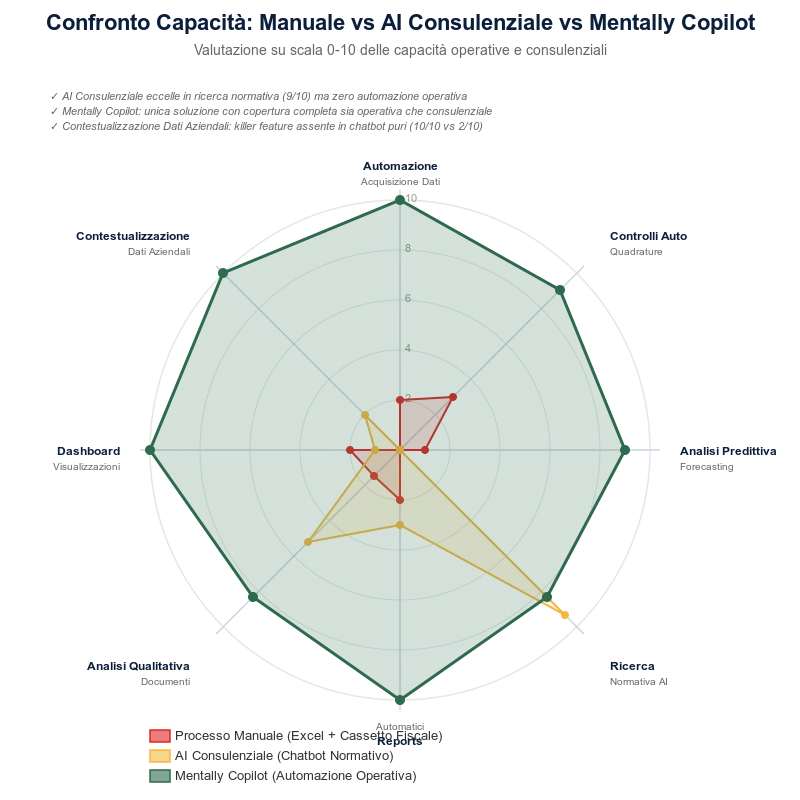
The 8 Controls Transformed by Automation
Let’s see what concretely changes in Marco’s week.
1. Invoice, Withholding, and Contribution Reconciliations
Before: Cassetto fiscale → Manual download → Excel → SUMIF() formula → Visual discrepancy check → Error search
After: Automatic acquisition from cassetto fiscale + Immediate alerts on reconciliation anomalies
2. F24 Control Prepared by Multiple Parties
Before: Firm prepares F24 → External commercialista prepares F24 → Client prepares F24 independently → Marco downloads everything → Verifies totals → Searches for errors and duplicates
After: Unified multi-source view with automatic flags on anomalous amounts or missing payments
3. Certificazioni Uniche for Tax Returns
Before: Download all client’s CU certificates → Transcribe data into tax return model → Verify amount consistency → Manually complete
After: CU data already structured, aggregated, and ready for tax return pre-completion
4. Expense, VAT, and Fixed Asset Classification
Before: Open each incoming invoice → Check accounting category → Correct classification errors → Recalculate VAT rates
After: AI automatically categorizes + Signals anomalies (“this €15,000 invoice might be a fixed asset”, “22% VAT unusual for construction supplies”)
5. FatturaPA Analysis and Customer/Supplier Concentration
Before: Export invoices → Pivot table in Excel → Create Pareto charts → Report in Word → Formatting
After: Automatic dashboard with top 10 suppliers, risk concentration indices, year-over-year comparative analysis
6. IRES, IRAP Scenarios and Tax Forecasting
Before: “What if the client invoices €50,000 more in Q4?” → Open Excel sheet → Modify revenue cell → Recalculate → Verify impact on IRES (Italian corporate income tax) and IRAP (Italian regional production tax)
After: “Give me three scenarios: unchanged revenue, +10%, +25%” → AI produces complete tax forecasting in 30 seconds
7. Regulatory Applicability to Specific Case
Before: Search for Agenzia delle Entrate circular on website → Read document → Try to understand if it applies to your specific client → Interpretative doubt → Re-read
After: “Does circular 24/E of 2024 apply to my SRL with €2M revenue, 15 employees, and public contracts?” → AI analyzes regulation AND company data together
This is impossible with purely consultative chatbots: without the client’s operational data, the answer remains generic.
8. Compliance Reports and Firm Archiving
Before: Manually create summary report → Save in client folder → Archive documents → Send via email
After: Auto-generated reports with updated data, saved in structured archive, ready for automatic sending
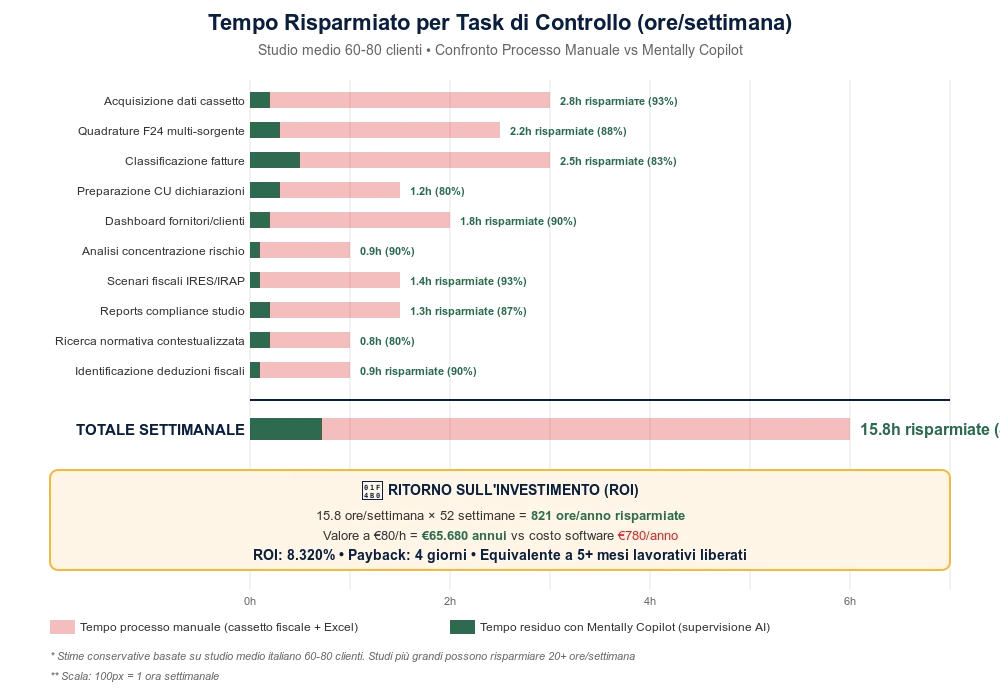
When You Need What: The Decision Matrix
There’s no “better” approach in absolute terms. There’s the right approach for how your firm works today.
When consultative assistant suffices:
- You primarily do high-value regulatory advisory
- Your operational controls are already digitized with efficient tools
- You have junior staff dedicated exclusively to operational activities
- The problem isn’t time, but interpretative quality
When operational automation is needed:
- You supervise 40+ clients with recurring monthly/quarterly controls
- You lose 10-15 hours weekly between cassetto fiscale, Excel, and manual reconciliations
- You want to transform controls managers from operators to strategists
- The firm’s bottleneck is time, not regulatory expertise
Estimated savings: For an average firm (60-80 clients), operational automation frees approximately 15 hours weekly per controls manager. Time that can be reinvested in high-value advisory or acquiring new clients.
The real transformation: From “operational controller” drowning in clicks and manual copies to “strategic supervisor” who analyzes, forecasts, and advises.
Conclusion: The Question That Matters
Marco today dedicates 3 hours weekly to just the “Rossi Costruzioni SRL” client. Of these 3 hours:
- 2 hours and 15 minutes are cassetto fiscale → Excel → manual controls
- 45 minutes are analysis, interpretation, and real advisory
Consultative AI would improve those 45 minutes. Operational automation would eliminate those 2 hours and 15 minutes.
The key question for your firm is simple: How much time do you lose every week on manual operations that a machine could do better than you?
If the answer is “too much,” operational automation is the way. If the answer is “little, my problem is interpretative,” a consultative assistant may suffice.
Want to See How Automation Works in Practice?
Try Mentally Copilot for 14 days at €1 – Commercialisti Plan
No commitment, autonomous cancellation anytime.
For detailed comparison of operational vs. consultative functionalities, see the complete comparative table.
Data and Statistics
15 ore
70 clienti
8 controlli
30 secondi
85%
3 sorgenti
Frequently Asked Questions
- ## What is the Difference Between a Consulting AI Assistant and an Operational Automation System for Accountants? In Italy, businesses often seek innovative technologies to enhance their operations. Understanding the distinction between a **consulting AI assistant** and a **consultative automation system** is crucial for maximizing efficiency and compliance in the Italian market. ### What is a Consulting AI Assistant? A **consulting AI assistant** is designed to provide strategic insights and recommendations tailored to your business needs. This system leverages artificial intelligence to analyze data, forecast trends, and offer guidance on complex issues, such as tax compliance and regulatory adherence. #### Key Benefits of a Consulting AI Assistant: - **Personalization**: Offers tailored advice based on specific business contexts, such as navigating Italian regulations like **D.Lgs 231/2002** (Italian Corporate Criminal Liability Law). - **Strategic Insights**: Helps businesses make informed decisions about investments, operations, and compliance strategies. ### What is an Operational Automation System for Accountants? An **operational automation system** for accountants focuses on streamlining daily accounting tasks, such as invoicing, data entry, and financial reporting. This type of system automates routine operations, allowing accountants to focus on higher-value activities that require human expertise. #### Key Benefits of an Operational Automation System: - **Efficiency**: Reduces time spent on tedious tasks, improving overall productivity. - **Accuracy**: Minimizes human errors in financial documents and data processing, which is critical for compliance with Italian standards and reporting requirements. ### How Do They Work Together? While both systems serve distinct purposes, they can complement each other's functionalities in the Italian business environment. A consulting AI assistant can offer strategic input that informs operations, whereas an operational automation system can execute the tasks required to fulfill those strategies effectively. ### Practical Implications for Cross-Border Operations For foreign companies looking to enter the Italian market, utilizing both technologies can enhance operations significantly. The consulting AI assistant can help navigate complex regulations, while the operational automation system ensures compliance and efficiency in financial processes. This combination can lead to smoother operations and better resource allocation. ### Why You Need Professional Services Engaging with professionals, such as a **commercialista** (Italian CPA and business advisor), is essential when implementing these technologies. They provide local expertise on regulatory requirements, assist in choosing the right systems, and ensure that your business remains compliant with Italian laws. ### Conclusion Understanding the difference between a consulting AI assistant and an operational automation system can enhance your company’s approach to business in Italy. Leveraging both technologies, along with professional services, can empower your operational efficiency while ensuring compliance with the regulatory landscape. For more insights on how to effectively integrate technology into your business strategy in Italy, consider reaching out to industry experts today.
- An AI advisory assistant is a chatbot specialized in tax regulations that answers queries, interprets circulars, and generates legal opinions, but does not engage with the operational processes of the firm. On the other hand, operational automation replaces repetitive manual processes: it automatically acquires documents from the fiscal drawer, performs reconciliation checks without human intervention, generates predictive analyses on taxes, and produces automatic reports. In summary, the first supports advisory work, while the second eliminates the manual tasks that precede high-value consulting.
- ### How Much Time Can an Accounting Firm Save with Operational Automation of Controls? In Italy, the adoption of operational automation can significantly impact accounting firms by streamlining their processes and reducing the time spent on manual tasks. This means that firms can prioritize more strategic activities that enhance client relations and grow their business. ### The Role of Automation in an Accounting Firm Implementing automation tools in an accounting firm allows for the efficient handling of repetitive tasks such as data entry, reconciliation, and compliance checks. For example, software that integrates with the **FatturaPA** (Italy's mandatory B2B e-invoicing system) can minimize the team’s workload by automating invoice handling and ensuring compliance with local regulations. ### Time Savings: A Quantitative Perspective According to recent studies, accounting firms that implement automation can save up to 50% of the time usually dedicated to controls and compliance tasks. This is particularly relevant for firms managing large volumes of transactions and various client accounts. For instance, if an accounting firm typically spends 40 hours a week on manual controls, automation could potentially reduce this to just 20 hours. ### Practical Implications for Cross-Border Operations For foreign companies operating in Italy, understanding the time savings from automation can aid in strategic planning and budgeting. It is essential to grasp how Italian accounting firms leverage automation to facilitate cross-border compliance, which can significantly affect operational efficiency. ### When to Consider Professional Services As regulations such as the **D.Lgs 231/2002** (Italian Corporate Criminal Liability Law) become more complex, the need for professional services rises. Companies operating in Italy often seek the counsel of a **commercialista** (Italian CPA and business advisor) to navigate these complexities. Their expertise, combined with automated tools, can provide a robust framework for compliance, ultimately saving time and minimizing risks. ### Conclusion and Call to Action In conclusion, the operational automation of controls within accounting firms can lead to substantial time savings, allowing firms to focus on growth and enhancing client experiences. For foreign businesses in Italy, understanding these efficiencies can translate into a competitive advantage. If you're considering automating your accounting processes or seeking a reliable **commercialista**, reach out to us today to explore how we can support your operations in Italy.
- In a medium-sized firm with 60-80 clients, operational automation frees up approximately 15 hours per week for each compliance manager. These hours are recovered by eliminating repetitive manual tasks such as downloading from the tax drawer, copying data into Excel, performing manual reconciliations, and generating reports. The time saved can be reinvested in high-value consulting or in acquiring new clients.
- **What Tax Controls Can Be Automated with Artificial Intelligence?** In Italy, businesses can significantly enhance their tax compliance processes by employing Artificial Intelligence (AI) technology. This means that through automation, companies can streamline operations, reduce manual errors, and ensure adherence to the complex Italian tax regulations. ### How Can AI Transform Tax Controls? AI can automate several key aspects of tax controls, including: 1. **Data Collection and Management** AI systems can gather and manage vast amounts of financial data, minimizing the need for manual input. This means that businesses can ensure that their records are constantly updated and accurate. 2. **Real-time Compliance Monitoring** AI tools can monitor transactions in real-time to ensure they comply with Italian regulations, including the requirements set by the *Agenzia delle Entrate* (Italian Revenue Agency). This proactive approach helps avoid compliance issues before they escalate. 3. **Automated Risk Assessment** AI can evaluate and identify financial risks by analyzing patterns in data. This means businesses can proactively address potential tax issues, reducing audit risks and improving overall financial health. 4. **E-invoicing Automation** With *FatturaPA* (Italy's mandatory B2B e-invoicing system), AI can automate the creation, submission, and tracking of invoices. This ensures compliance with e-invoicing regulations, streamlining cash flow processes. ### What Are the Benefits of Automating Tax Controls? The automation of tax-related tasks through AI delivers several advantages for businesses operating in Italy: - **Increased Accuracy** By reducing human error in tax reporting and compliance, businesses can achieve higher accuracy in their financial statements. - **Time Savings** Automation frees up accounting and finance teams from tedious tasks, allowing them to focus on strategic initiatives. - **Cost Efficiency** Reducing manual processes can lead to significant cost savings, especially for cross-border operations where compliance complexity increases. - **Enhanced Reporting Capabilities** Automated systems can offer comprehensive reporting features, allowing for better insights and decision-making. ### When Should Companies Consider Automation? Companies should consider automating their tax controls when: - They experience repetitive manual tasks that slow down operations. - They are facing compliance challenges in navigating Italian tax regulations, such as the *D.Lgs 231/2002* (Italian Corporate Criminal Liability Law). - They aim to improve their financial reporting accuracy and efficiency. ### Conclusion Adopting AI for tax compliance not only meets the demand for accuracy and efficiency but also positions companies favorably in the competitive Italian market. As businesses grow and expand, understanding and utilizing the potential of AI in tax controls becomes essential. For organizations looking to navigate the nuances of the Italian regulatory landscape, partnering with a *commercialista* (Italian CPA and business advisor) can provide valuable insights and ensure compliance. **Ready to transform your tax compliance processes? Contact us today to learn more about how AI can support your business operations in Italy!**
- AI can automate eight main types of controls: invoice and withholding reconciliations with alerts for anomalies, monitoring F24 forms prepared by multiple parties, acquisition and structuring of Certificazioni Uniche (Unique Certifications), automatic classification of VAT expenses and fixed assets, analysis of public administration invoices and client/supplier concentration, IRES (Corporate Income Tax) and IRAP (Regional Tax on Productive Activities) forecasting scenarios, regulatory application to specific cases with business data analysis, and automatic generation of compliance reports for studio (firm) archiving.
- ## How Does the Automation of the Tax Drawer Work at the Agenzia delle Entrate? In Italy, the **cassetto fiscale (tax drawer)** is an essential tool for taxpayers and businesses to manage their tax positions with the Agenzia delle Entrate (Italian Revenue Agency). This online portal is designed to provide a comprehensive overview of a taxpayer's fiscal situation, including taxes owed, payments made, and relevant declarations. The automation of this system streamlines numerous processes, improving efficiency and accessibility. ### What is the Tax Drawer? The tax drawer allows taxpayers to access their tax documents electronically, facilitating easier management of their tax liabilities. Under Italian law, taxpayers—including businesses—must keep updated records of their fiscal activities, and the tax drawer serves as a centralized hub for this information. ### How Does Automation Improve Functionality? 1. **Real-Time Access to Information**: Automation enables real-time updates regarding tax obligations and payments. Businesses can quickly view any outstanding amounts, payment deadlines, and their fiscal history. 2. **Easier Compliance**: The automated system assists businesses in maintaining compliance with Italian tax regulations. By providing timely notifications regarding deadlines and any changes in tax laws, businesses are less likely to incur penalties for late payments or insufficient reporting. 3. **Simplified Filing Process**: The tax drawer allows businesses to file their tax returns electronically through FatturaPA (Italy's mandatory B2B e-invoicing system), simplifying the submission process and reducing the chances of error. 4. **Data Integration**: Automation allows for seamless integration with other governmental systems, such as the Sistema Tessera Sanitaria (Italian Healthcare Card System), making it easier for businesses to manage multiple regulatory requirements. ### Why Should Businesses Leverage the Tax Drawer? 1. **Cost Efficiency**: Automating tax management reduces administrative burdens and the need for extensive paperwork, allowing companies to allocate resources more effectively. This is especially crucial for foreign companies navigating Italian bureaucracy. 2. **Enhanced Accuracy**: Automated systems minimize human error, ensuring that tax filings reflect accurate data. This is vital in Italy, where compliance with local tax laws is rigorously monitored by the Agenzia delle Entrate. 3. **Timely Insights**: The ability to access financial data quickly aids in strategic decision-making, allowing businesses to plan better and react promptly to regulatory changes. ### Conclusion In conclusion, the automation of the tax drawer at the Agenzia delle Entrate significantly enhances the ability of businesses to manage their tax obligations effectively. By providing real-time access to crucial tax information, simplifying compliance, and improving accuracy, the system serves as a vital resource for foreign companies operating in Italy. Leveraging this tool not only fosters compliance but also promotes efficiency in the overall management of business operations within the Italian market. If your business is looking to navigate Italian tax regulations more effectively, consider consulting with a **commercialista (Italian CPA and business advisor)** to ensure you maximize the benefits of the cassetto fiscale and remain compliant with Italian tax laws.
- **How Tax Drawer Automation Transforms Financial Reporting in Italy** Tax drawer automation eliminates the manual process of access, downloading, and data transcription. The system automatically acquires documents such as Certificazioni Uniche (Single Certifications), modelli F24 (F24 forms), and passive invoices, structures them in a processable format, and performs reconciliation checks without human intervention. Immediate alerts are generated for anomalies or discrepancies, replacing hours spent on downloading, copying to Excel, and manually verifying data for each client. This shift not only streamlines operations but also dramatically reduces the risk of human error, allowing companies to focus on strategic financial decision-making rather than tedious data management tasks. By capitalizing on tax drawer automation, businesses can enhance accuracy, speed, and compliance in their financial reporting. **Why You Should Invest in Tax Drawer Automation** In the Italian market, where regulatory compliance is paramount, automating these processes ensures that your business adheres to local laws and reduces the burden of manual data handling. With the Agenzia delle Entrate (Italian Revenue Agency) requiring precise documentation and reporting, leveraging automation can give your company a competitive edge. Are you ready to transform your financial reporting? Implementing tax drawer automation can save significant time and resources, allowing your team to concentrate on core business functions. Don’t get left behind—embrace the future of financial management today!
- ## When Should an Italian Accounting Firm Choose Operational Automation Over an AI Consulting Assistant? In Italy, accounting firms often face the dilemma of choosing between operational automation and the integration of an AI consulting assistant. Understanding the circumstances that favor one option over the other can significantly enhance overall efficiency and service offerings. ### What is Operational Automation in Accounting? Operational automation refers to the use of technology to streamline repetitive accounting processes, such as bookkeeping, data entry, and financial reporting. This approach allows firms to reduce manual intervention and minimize errors, leading to increased productivity. ### When Should Firms Opt for Operational Automation? 1. **High Volume of Routine Tasks** Accounting firms dealing with large volumes of standard transactions, such as invoicing or payroll processing, should prioritize operational automation. This shift can free up valuable time for accountants to focus on strategic activities and client relationships. 2. **Need for Consistency and Accuracy** In situations where precision is paramount—like tax calculations or regulatory compliance—operational automation can help ensure that all processes are executed correctly, reducing the likelihood of human error. 3. **Cost Efficiency** Firms looking to scale their operations without proportional increases in overhead costs may find that investing in automation technologies yields substantial long-term savings. For example, automating a process that previously required multiple staff members can lead to significant reductions in labor costs. ### Why Choose an AI Consulting Assistant? On the other hand, an AI consulting assistant can greatly enhance the decision-making process in certain scenarios: 1. **Complex Problem Solving** When faced with unusual financial situations or intricate regulatory compliance challenges, firms may benefit more from an AI consulting assistant that provides tailored insights and recommendations based on advanced data analytics. 2. **Personalized Client Interactions** For firms that prioritize client engagement and personalized service, an AI assistant can offer customized support, helping accountants provide more value to clients by analyzing specific business needs. 3. **Continuing Education and Support** An AI consulting assistant can serve as an ongoing resource for accountants, offering updates on changing regulations and best practices, which is particularly useful in Italy's dynamic regulatory environment. ### Balancing Both Approaches Ultimately, the choice between operational automation and an AI consulting assistant doesn't have to be mutually exclusive. Firms can adopt a hybrid model that leverages the strengths of both technologies. For example, automating routine tasks can allow firms to allocate resources toward employing an AI consultant who can tackle more nuanced issues, thereby maximizing efficiency across the board. ### Conclusion In conclusion, the decision for an Italian accounting firm to choose operational automation over an AI consulting assistant—or to implement both—depends significantly on specific operational needs and client demands. Firms must assess their workflow, volume of transactions, and the complexity of their client needs to determine the most strategic approach. If your firm is considering the shift to operational automation or enhancing its capabilities with an AI consulting assistant, now is the time to evaluate potential technologies that can transform your practice. Embrace innovation and streamline your operations to better serve your clients in the competitive Italian market.
- Operational automation is the right choice when you oversee more than 40 clients with recurring monthly or quarterly controls, lose 10 to 15 hours a week between tax drawer management and manual Excel reconciliations, aim to transform control managers from operators to strategists, and the bottleneck in your firm is time, not regulatory expertise. On the other hand, a consulting assistant is sufficient when the main issue is interpretative quality and operational processes are already efficiently digitized.
- **Can Artificial Intelligence Generate Automatic Tax Forecasting Scenarios for IRES and IRAP?** In Italy, artificial intelligence (AI) holds significant potential for the automation of tax forecasting scenarios, specifically for corporate income tax (IRES) and regional production tax (IRAP). This means that businesses can effectively streamline their tax planning processes, ultimately enhancing compliance and optimizing financial performance. **What are IRES and IRAP?** IRES (Imposta sul Reddito delle Società) refers to the corporate income tax that Italian companies must pay on their profits, currently set at a rate of 24%. IRAP (Imposta Regionale sulle Attività Produttive) is a regional tax applied to the production activities of businesses, with rates varying by region but typically around 3.9%. Understanding these taxes is crucial for foreign companies operating in Italy, as they directly impact profitability and tax obligations. **How Can AI Assist in Forecasting IRES and IRAP?** AI technologies can analyze historical data, including past financial statements and market trends, to predict future tax liabilities for both IRES and IRAP. By leveraging machine learning algorithms, these systems can provide predictive analytics that consider various business scenarios, ultimately allowing companies to make informed decisions regarding their tax strategies. **What are the Practical Implications for Cross-Border Operations?** For foreign companies operating in Italy, leveraging AI for tax forecasting can simplify the complexities of Italian tax regulations. This integration leads to more accurate estimations of tax liabilities, reduces the risk of compliance issues, and improves cash flow management. Consequently, businesses can allocate resources more effectively and enhance operational efficiency in a foreign market. **When Should Companies Consider Professional Services?** While AI can significantly enhance tax forecasting capabilities, the intricacies of Italian tax law still necessitate the expertise of professionals. Companies should consider enlisting the services of a *commercialista* (Italian CPA and business advisor) early on to navigate complexities and ensure compliance with legal requirements. A *commercialista* can also provide context-specific insights that AI might not capture, especially for unique business situations. **Conclusion: The Future of Tax Forecasting in Italy** The integration of AI in tax forecasting for IRES and IRAP presents a transformative opportunity for businesses in Italy. By automating this process, companies can achieve greater accuracy and efficiency while minimizing risks related to compliance. As firms increasingly navigate the Italian tax landscape, embracing AI technology, supplemented by professional advice, will be key to optimizing their operations. **Call to Action: Explore AI Solutions for Your Business** Are you a foreign company looking to enhance your tax forecasting capabilities in Italy? Discover how Mentally.ai can automate your accounting processes, ensuring compliance and efficiency, while freeing up your time to focus on growth. Contact us today for a demo!
- Yes, operational automation systems can generate comprehensive tax forecasting in just seconds. Instead of manually adjusting Excel cells to simulate scenarios, AI automatically produces forecasts of the impact on IRES (corporate income tax) and IRAP (regional production tax) based on varying assumptions of revenue or other business parameters. For instance, it can instantly calculate three parallel scenarios with unchanged revenue, a 10% increase, or a 25% increase, providing an immediate comparative view.
- ## How Can AI Verify if an Italian Revenue Agency Circular Applies to My Specific Client? In Italy, the **Agenzia delle Entrate** (Italian Revenue Agency, equivalent to IRS) frequently issues circulars that provide guidance on tax laws and regulations. Understanding if a specific circular applies to your client is crucial for ensuring compliance and optimizing tax strategies. AI can play a pivotal role in this process. ### How Does AI Analyze Circulars for Applicability? AI algorithms can efficiently process and analyze vast amounts of legal text. They use natural language processing (NLP) to identify key phrases and concepts within the circulars that relate to your client's specific circumstances. This capability means that AI can: - **Extract Relevant Information:** AI can quickly identify relevant sections of circulars pertaining to specific industries, tax situations, or client profiles. - **Cross-Reference Client Data:** By integrating client-specific data (such as business sector, revenue, and historical tax issues), AI can assess compatibility with the guidance provided in circulars. ### What Are the Benefits of Using AI for This Verification? Using AI for circular applicability verification presents several advantages: 1. **Efficiency:** Manual review of circulars can be time-consuming. AI significantly reduces the time needed to extract and analyze information. 2. **Accuracy:** With a high level of precision in processing text, AI minimizes the risk of overlooking critical compliance issues. 3. **Scalability:** AI can easily scale to analyze multiple circulars simultaneously, making it ideal for large firms or those with numerous clients. ### What Practical Implications Are There for Cross-Border Operations? For foreign companies operating in Italy, understanding local tax regulations is crucial. AI can provide actionable insights into how Italian bureaucratic nuances may affect their compliance and operational strategies. By having a precise understanding of relevant circulars, companies can make informed decisions that mitigate risk and capitalize on potential tax advantages. ### How Can You Implement AI Solutions for Your Client? To leverage AI in verifying the applicability of the **Agenzia delle Entrate** circulars, consider the following steps: - **Invest in AI Tools:** Select an AI accounting automation platform that specializes in Italian tax and regulatory content, like Mentally.ai. - **Integrate Client Data:** Set up systems that allow the AI to access and analyze client data in conjunction with circulars. - **Consult with Experts:** Even with AI tools, maintaining collaboration with a **commercialista** (Italian CPA and business advisor) ensures that you are interpreting data and insights accurately. ### Conclusion AI can significantly enhance the process of verifying whether an **Agenzia delle Entrate** circular applies to your specific client. Its ability to quickly analyze complex texts, coupled with the integration of client-specific data, provides a powerful tool for ensuring compliance and optimizing tax strategies in Italy. Investing in AI solutions not only streamlines operations but also supports foreign companies in navigating the complexities of the Italian regulatory landscape. ### Call to Action Ready to explore how AI can boost your compliance efforts in Italy? Contact us today to learn more about our AI-driven solutions tailored for foreign businesses navigating the Italian market!
- Integrated operational automation systems simultaneously analyze regulatory frameworks and the client's business data. Unlike purely advisory chatbots that provide generic responses, these tools can answer specific questions such as, "Does Circular 24/E of 2024 apply to my SRL (società a responsabilità limitata, or limited liability company) with €2 million (~$2.16 million USD) in revenue, 15 employees, and public contracts?" by cross-referencing regulatory content with the specific operational characteristics of the company already present in the system.
- ## What manual activities are time-consuming for accountants that automation eliminates? In the Italian market, accountants (commercialisti) face numerous manual tasks that consume valuable time and resources. Automation can significantly streamline these activities, allowing accountants to focus on higher-value services. Here are some of the most time-consuming manual activities that automation can eliminate: ### 1. Data Entry and Processing Manual data entry is one of the most labor-intensive tasks. Accountants often spend hours inputting financial data from various sources into accounting software. **Implication:** Automation tools can extract and process this data directly, reducing human error and increasing efficiency. ### 2. Invoicing and Billing Creating and sending invoices is a repetitive task for accountants. They need to ensure accuracy in amounts, tax calculations, and payment terms, which can become tedious. **Implication:** Automated invoicing systems, like FatturaPA (Italy's mandatory B2B e-invoicing system), can generate and send invoices automatically, improving cash flow management. ### 3. Tax Return Preparation Preparing tax returns requires compiling extensive data, ensuring compliance with regulations, and accurately calculating taxes owed. **Implication:** Tax automation software can significantly reduce the time spent on tax preparation by automating calculations and generating necessary forms, ensuring compliance with the Agenzia delle Entrate (Italian Revenue Agency). ### 4. Reconciliation Processes Reconciling bank statements and financial records can consume a lot of time, often requiring meticulous attention to detail. **Implication:** Automation can facilitate the reconciliation process by automatically matching transactions and highlighting discrepancies, leading to faster and more accurate reconciliations. ### 5. Client Communication Accountants often spend a significant amount of time communicating with clients, whether to request information or provide updates. **Implication:** Automated communication tools can standardize responses and follow-ups, improving client relationships while freeing up time for accountants. ### 6. Report Generation Generating financial reports requires collating data from various sources, which can take considerable time. **Implication:** Automated reporting tools can quickly compile this data and generate customizable reports, allowing accountants to provide timely insights to clients. ### Conclusion By eliminating these manual tasks, automation not only saves time but also enhances accuracy and compliance. For foreign companies operating in Italy, integrating automated accounting solutions can lead to significant operational efficiencies, allowing businesses to navigate the complexities of Italian regulations and focus on growth. **Call to Action:** Consider leveraging automation tools tailored for the Italian market to transform your accounting practices. A qualified commercialista can guide you on the best solutions for your business needs.
- The most time-consuming manual tasks eliminated by automation include: repeated access to the tax drawer for document downloads, copying and pasting data from PDF to Excel, manually creating pivot tables for VAT controls, visually verifying reconciliations between invoices and withholding tax, searching for and transcribing data from Unique Certifications, manually classifying expenses and assets, creating formatted summary reports, and document archiving for each client. These operations can consume over 2 hours per client per quarter.