{ "metaTitle": "Hiring CFO vs AI Software Italy: Cost Calculations 2025", "metaDescription": "Compare hiring a CFO vs AI software for SMEs in Italy. Discover cost differences (€25K vs €5K/year) and ROI calculations. Which is right for your business?", "primaryKeyword": "hiring cfo vs ai software italy cost", "secondaryKeywords": ["cfo costs italy", "ai software roi italy", "small business financial management", "how to reduce finance costs italy", "cfo vs ai solutions"] }
{ "metaTitle": "CFO AI vs Human CFO in Italy: Costs & ROI Comparison 2024", "metaDescription": "Explore CFO options in Italy: human vs AI. Learn real scenarios, cost differences, and ROI analysis for SMEs. Which one suits your business needs?", "primaryKeyword": "CFO comparison Italy", "secondaryKeywords": ["AI CFO Italy", "human CFO costs Italy", "ROI AI CFO", "predictive intelligence CFO", "SME financial management Italy"] }
Key Takeaways
- A part-time CFO in Italy actually costs €60,300 (~$64,000 USD) annually (not €36,000 RAL, which stands for "reddito annuale lordo" or gross annual income), when you include contributions to INPS (Istituto Nazionale della Previdenza Sociale or National Institute of Social Security), TFR (Trattamento di Fine Rapporto or Severance Pay), workstation expenses, training, and coverage for absences. In contrast, a full-time CFO's total expense reaches €124,900 (~$133,000 USD), whereas an AI software solution costs only €9,000 (~$9,600 USD).
- The AI software generates unlimited what-if scenarios in just 30 seconds and provides real-time predictive cash flow connected to five data sources (Agenzia delle Entrate (Italian Revenue Agency), ERP, banks, CR, PCC PA), compared to the three hours it takes a CFO to create a single scenario.
- The three-year savings from choosing AI software instead of a part-time CFO amounts to €153,900 (~$165,000 USD). This is equivalent to the cost of hiring 2-3 senior accountants (commercialisti) or reinvesting in research and development (R&D) for a small to medium-sized enterprise (PMI).
- ### What is the Best AI Software ROI for Different Revenue Levels in Italy? In Italy, businesses with a revenue under €10 million (~$11 million USD) find that AI software delivers the best return on investment (ROI). This means that for smaller companies, leveraging AI can significantly enhance operational efficiency and cost-effectiveness. ### How Does the Revenue Range Affect Technology Adoption? For companies generating between €10 million (~$11 million USD) and €20 million (~$22 million USD), a hybrid approach is effective. This strategy typically combines the use of AI software with occasional Chief Financial Officer (CFO) consulting. The inclusion of a CFO advisor helps navigate the complexities of financial management while still optimizing the benefits of AI technology. ### When is a Full-Time CFO Necessary? For businesses with revenues exceeding €20 million (~$22 million USD), the presence of a full-time CFO becomes strategically necessary. Under Italian regulations, larger companies face more complex compliance and financial reporting requirements, making it imperative to have a dedicated financial leader to oversee these challenges and drive growth. ### What Are the Implications for Foreign Companies? Foreign companies operating in Italy should consider these revenue benchmarks when evaluating their investment in AI and financial consulting services. Understanding the financial dynamics and regulatory environment is crucial for successful operations in the Italian market. ### Why Invest in AI and CFO Consulting? Investing in AI software not only enhances operational efficiency but also prepares companies for better compliance and strategic financial decision-making. Engaging a CFO consultant can bridge the gap for mid-sized firms, ensuring they remain competitive and compliant as they scale. ### Call to Action Explore how AI software can transform your business's financial operations in Italy. Consider consulting with local experts to tailor a strategy that aligns with your revenue targets and operational needs.
- The AI software operates 720 hours monthly with 24/7 availability, compared to the 72 hours of a part-time CFO limited to three days a week. This ensures continuous monitoring and predictive alerts with a 60-day lead time.
- The critical limitation of AI software is the lack of necessary human strategic judgment indispensable for M&A (mergers and acquisitions), complex banking negotiations, investor relations, and corporate restructuring, which require soft skills and physical presence.
- A part-time CFO excels in qualitative strategic decisions but cannot cover the daily operations of companies with revenues over €10 million (~$10.8 million USD). This role is optimal for providing targeted consultancy alongside AI software for routine management.
Summary
For Italian SMEs (small and medium-sized enterprises) with revenues between €3 million and €50 million (~$3.3 million to ~$54 million USD), hiring a CFO (Chief Financial Officer) costs between €60,300 (~$65,000 USD) annually for a part-time position (3 days a week) and €124,900 (~$135,000 USD) for a full-time position. These figures consider all hidden costs, including social security contributions (INPS), severance pay (TFR), workspace expenses, and training. In contrast, an AI-driven management control software costs merely €9,000 (~$9,600 USD) annually (or €750 (~$800 USD) monthly) and offers superior operational capabilities in terms of speed and scalability. It generates unlimited what-if scenarios in 30 seconds versus the 3 hours required by a CFO for manual analysis. Moreover, it provides real-time predictive cash flow linked to five data sources (Agenzia delle Entrate – Italian Revenue Agency, ERP systems, banks, Centrale Rischi – Central Risk Repository, and PCC PA – Public Administration Cash Management) and analyzes margins across all clients without limitations. The AI software excels in automating repetitive tasks and is available 24/7. However, it lacks the essential human strategic judgment required for complex operations such as mergers and acquisitions (M&A), banking negotiations, and investor relations. The optimal solution depends on revenue: for companies under €10 million (~$11 million USD), the AI software offers the best ROI (return on investment); for those between €10 million and €20 million (~$11 million to ~$22 million USD), a hybrid approach (software combined with occasional CFO consulting) is effective; and for companies over €20 million (~$22 million USD) or those engaging in extraordinary operations, a full-time CFO becomes justifiable. Choosing AI software instead of a part-time CFO results in a three-year savings of €153,900 (~$164,000 USD), which can be reinvested in commercial growth or innovation.
Assumere un CFO o Usare un Software AI: Calcolo Costi e ROI per PMI 2025
Il Dilemma che Blocca i CEO delle PMI Italiane
Laura Fontana, CEO di TechServe Italia, fissa il preventivo del CFO senior sul tavolo: 85.000 euro all’anno, più contributi. Per la sua azienda di servizi IT da 8,2 milioni di fatturato, significa quasi il 10% dell’utile operativo. Il commercialista è stato chiaro: “Laura, la situazione è complessa. Ti serve un Chief Financial Officer vero, non più Excel.”
Il giorno dopo, durante un aperitivo con colleghi imprenditori, Marco le racconta di aver implementato un software AI per il controllo di gestione. Costo: 750 euro al mese. “Risparmio 60.000 euro all’anno rispetto al CFO part-time che stavo valutando,” dice mentre le mostra dashboard real-time sul telefono.
Laura torna in ufficio confusa. Chi ha ragione? Quando serve davvero un CFO umano? Quando basta l’intelligenza artificiale? E soprattutto: quanto costa realmente ogni opzione, costi nascosti inclusi?
Questa è la domanda che paralizza migliaia di imprenditori italiani con fatturati tra 3 e 50 milioni. La risposta non è semplice, ma è quantificabile. Vediamo i numeri.
La Verità sui Costi: Cosa Paghi Realmente
Il primo errore degli imprenditori è guardare solo la retribuzione annua lorda. Un CFO che chiede 75.000 euro non costa 75.000 euro. Costa significativamente di più.
Breakdown Completo: Costi Annuali Reali
| Voce di Costo | CFO Part-Time (3gg/sett) | CFO Full-Time | Software AI |
|---|---|---|---|
| Retribuzione lorda | €36.000 | €75.000 | €0 |
| Contributi INPS/INAIL | €10.800 | €22.500 | €0 |
| TFR accantonamento | €2.600 | €5.500 | €0 |
| Costo postazione | €2.400 | €4.800 | €0 |
| Licenze software individuale | €1.800 | €3.600 | Incluso |
| Formazione continua | €2.000 | €4.000 | Auto-update |
| Sostituzione assenze/ferie | €3.500 | €7.000 | N/A |
| Onboarding iniziale | €1.200 | €2.500 | €0 |
| Subscription piattaforma | - | - | €9.000 |
| TOTALE ANNO 1 | €60.300 | €124.900 | €9.000 |
| TOTALE 3 ANNI | €180.900 | €374.700 | €27.000 |
La matematica è brutale. Il CFO part-time che “costa 3.000 euro al mese” in realtà assorbe 5.025 euro mensili effettivi. Il full-time arriva a 10.408 euro al mese, non i 6.250 della RAL.
Il software AI rimane fisso a 750 euro. Zero costi nascosti, zero sorprese.
Ma i costi sono solo metà della storia. L’altra metà è: cosa ottieni per quello che paghi?
Confronto Capacità Operative: Il Tempo è Denaro
Un CFO part-time lavora 72 ore al mese. Un software AI lavora 720 ore al mese, 24/7. Ma la quantità non è qualità. Vediamo cosa produce ciascuna opzione concretamente.
Tabella Comparativa: Cosa Ottieni Realmente
| Funzionalità | CFO Part-Time | CFO Full-Time | Software AI |
|---|---|---|---|
| Forecast IRES/IRAP trimestrale | 6h setup + 2h/trim | 4h/trim | 30 secondi conversazionale |
| Cash flow predittivo | Excel aggiornamento mensile | Excel settimanale | Real-time 5 fonti (AdE, ERP, banche, CR, PCC PA) |
| Scenari what-if investimenti | 1 scenario/giorno (sequenziale) | 3-5 scenari/giorno | Illimitati paralleli in 30 secondi |
| Dashboard aggiornamento | Trimestrale | Mensile | Real-time ogni 6 ore |
| Analisi margini per cliente | Top 20 clienti | Top 50 clienti | Tutti i clienti, granularità infinita |
| Stress test liquidità | Manuale 3 ore | Manuale 1,5 ore | Automatico continuo, alert 60gg anticipo |
| Benchmark settoriale | Ricerca manuale consultancy | Report annuali | ML peer dinamico tempo reale |
| Disponibilità risposta | Lun-Mer-Ven 9-18 | Lun-Ven 9-18 | 24/7/365 istantanea |
| Scalabilità volume dati | Zero (vincolato 72h) | Limitata | Infinita |
Analisi narrativa critica:
Il CFO part-time è un ottimo strategist con giudizio qualitativo superiore, ma è limitato operativamente. 72 ore al mese non bastano per coprire l’operatività quotidiana di un’azienda da 10+ milioni. Eccelle nelle decisioni strategiche complesse, ma non può seguire il cash flow giornaliero o aggiornare scenari settimanali.
Il CFO full-time è completo. Presenza continua, gestisce emergenze, diventa strategic partner vero. Giustificato oltre 20 milioni di fatturato o in presenza di M&A, fundraising, ristrutturazioni. Sotto questa soglia, il costo-opportunità è pesante.
Il software AI domina l’automazione: velocità di esecuzione 100x superiore, scalabilità infinita, real-time intelligence inarrivabile da un umano. Ma ha limiti critici spesso ignorati:
- Manca giudizio strategico umano: M&A, negoziazioni complesse, investor relations richiedono presenza fisica e soft skills.
- Richiede tempo gestione: paradosso spesso trascurato. Anche se il software fa risparmiare tempo operativo, crea nuove azioni da gestire. Dashboard real-time = alert continui → il CEO deve decidere → tempo comunque dedicato. Non è “install and forget”, è “install and manage differently.”
- Non sostituisce il cervello umano per complessità qualitative non quantificabili.
Emerge una quarta opzione, spesso trascurata: l’approccio ibrido.
L’Opzione Ibrida: Il Sweet Spot per Fatturati €10-50M
Le aziende in questa fascia di fatturato hanno una complessità ibrida:
- Volume operazioni elevato (il software gestisce meglio del part-time)
- Decisioni strategiche frequenti (serve giudizio umano)
- Budget limitato (120.000 euro/anno per un full-time pesano)
- Part-time insufficiente (72 ore/mese non coprono l’operatività)
La soluzione ibrida combina software AI (750 euro/mese) con CFO part-time 1 giorno alla settimana (1.200 euro/mese). Totale: 1.950 euro/mese, 23.400 euro/anno.
Divisione Ruoli nell’Approccio Ibrido
| Attività | Chi la Gestisce | Tempo Richiesto |
|---|---|---|
| Forecast cash flow 12 mesi | Software AI (30 sec) | 30 min/mese CEO supervisione |
| Scenari what-if investimenti | Software AI (illimitati) | 1h/mese CEO analisi output |
| Quadrature F24/contabilità | Software AI (automatico) | 0 ore |
| Dashboard liquidità real-time | Software AI (continuo) | 30 min/sett CEO monitoring |
| Analisi margini clienti | Software AI (granulare tutti) | 0 ore |
| Budget strategico annuale | CFO part-time (workshop 2gg) | 16 ore/anno |
| Negoziazione banche/fidi | CFO part-time (presenza fisica) | 8 ore/anno |
| Decisioni M&A/acquisizioni | CFO part-time (due diligence) | 16 ore/anno |
| Board presentation investitori | CFO part-time (storytelling) | 12 ore/anno |
| Strategia fiscale avanzata | CFO part-time + commercialista | 8 ore/anno |
Costo annuale approccio ibrido:
- Software AI: 9.000 euro
- CFO 1 giorno/settimana (48 giorni × 600 euro): 28.800 euro
- Totale: 37.800 euro/anno
Confronto alternative:
- vs CFO full-time (124.900 euro): risparmio 87.100 euro (70%)
- vs CFO part-time 3gg/sett (60.300 euro): risparmio 22.500 euro (37%)
- vs Software solo (9.000 euro): +28.800 euro, ma aggiunge capacità strategica critica
Il software copre il 90% dell’operatività ripetitiva. Il CFO umano gestisce il 10% strategico ad alto valore. È il classico principio di Pareto applicato al controllo di gestione.
Caso Studio: Laura Fontana, TechServe Italia
Torniamo a Laura Fontana. A febbraio 2024, dopo il preventivo da 85.000 euro del CFO senior, Laura decide di testare l’approccio software. La sua situazione:
TechServe Italia Srl
- Settore: Managed Service Provider IT
- Sede: Bologna
- Fatturato 2023: 8,2 milioni
- Dipendenti: 42 tecnici
- Clienti: 120 PMI Emilia-Romagna
I tre problemi critici di Laura:
- Cash flow opaco: clienti ricorrenti con contratti mensili, ma crediti verso PA con ritardi sistematici 180 giorni = liquidità imprevedibile
- Margini ignoti: 15 tecnici esterni con costo variabile, impossibile sapere quali clienti sono davvero profittevoli
- Decisioni al buio: investire 200.000 euro in un nuovo datacenter? Assumere 8 tecnici fissi? Zero dati per decidere
Laura sceglie un test di 15 giorni gratuiti con Mentally Copilot. Setup: 4 ore con il commercialista per integrare TeamSystem. Costo: 750 euro/mese.
Risultati dopo 6 Mesi (Agosto 2024)
| KPI | Prima (Excel) | Dopo (AI) | Miglioramento |
|---|---|---|---|
| Forecast accuracy cash flow | ±35% errore | ±8% errore | +320% accuratezza |
| Tempo decisioni investimento | 12 giorni ricerca dati | 30 minuti scenari | 96% più veloce |
| Clienti marginali identificati | 0 (sconosciuti) | 18 su 120 (15%) | +40.000€/anno recuperati |
| Crisi liquidità evitate | 2 scoperti (15.000€ oneri) | 0 (alert 60gg prima) | 15.000€ risparmiati |
| Tempo Laura su finanza/settimana | 8 ore frustrazione Excel | 45 min conversazionale | 89% risparmio tempo |
ROI quantificato 6 mesi:
::chart[roi_techserve_italia_6_mesi_con_software_ai_cfo]
Breakdown benefici 6 mesi:
- Clienti marginali eliminati/rinegoziati: 40.000€/anno (20.000€ proporzionali in 6 mesi)
- Crisi liquidità evitate: 15.000€ oneri bancari scoperti
- Tempo CEO risparmiato: 180 ore × 80€/h valore = 14.400€
- Ottimizzazioni fiscali identificate: 8.100€ (deduzione ACE + super-ammortamenti non considerati)
Totale benefici 6 mesi: 57.500€ vs 5.250€ investimento = 995% ROI
Laura oggi dice: “Pensavo servisse un CFO umano da 85.000 euro. Poi ho capito che il 90% delle decisioni finanziarie sono pattern ripetitivi: questo cliente paga sempre con 25 giorni di ritardo, quel fornitore aumenta i prezzi a gennaio, la PA blocca i pagamenti per 6 mesi. Il software AI identifica questi pattern meglio di me e 100 volte più veloce. Per il 10% strategico vero—acquisizione di un competitor, cambio di business model, negoziazione bancaria complessa—bastano 2-3 consulenze all’anno con un CFO esterno. Costo: 3.000 euro contro 85.000 di uno stipendio fisso.”
Pattern Decisionale: Quale Opzione per la Tua PMI?
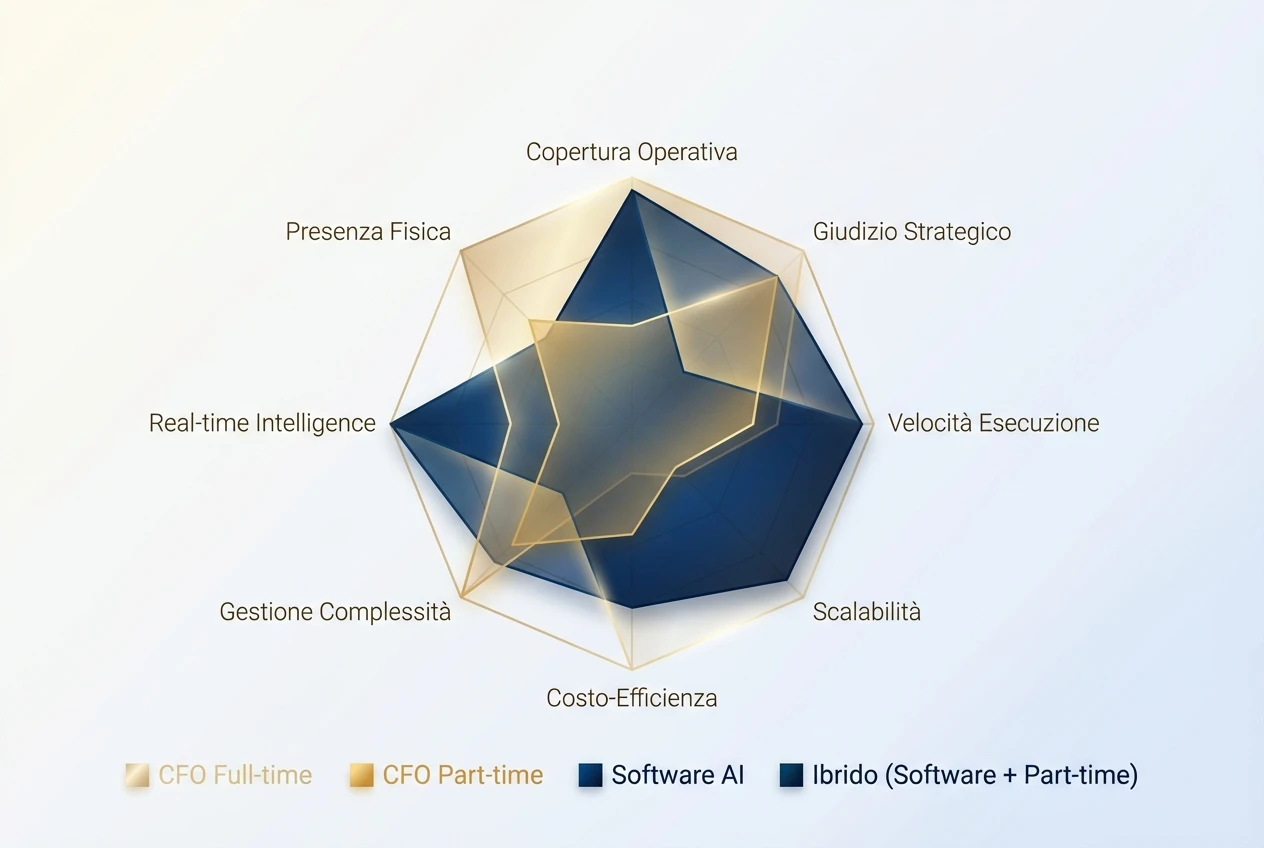
Ogni opzione ha un profilo distintivo di punti di forza e debolezza. Il grafico radar seguente confronta le quattro alternative su 8 dimensioni critiche.
::chart[pattern_decisionale_quale_opzione_per_la_tua_pmi]
Interpretazione dei Pattern
CFO Full-time (rosso): Eccelle in giudizio strategico (100), gestione complessità (100), presenza fisica (100). Debole in costo-efficienza (20) e scalabilità (30). Il profilo è quello di un’azienda matura con complessità strutturale: oltre 50 milioni di fatturato, M&A attiva, fundraising in corso, multi-entity internazionale.
CFO Part-time (arancione): Compromesso equilibrato senza eccellenze. Giudizio strategico buono (85) ma copertura operativa insufficiente (40). Real-time intelligence debole (30) perché non può aggiornare dashboard continuamente. Opzione di transizione per fatturati 5-10 milioni in fase di crescita.
Software AI (blu): Domina velocità esecuzione (100), scalabilità (100), real-time intelligence (100), costo-efficienza (100). Debolissimo in giudizio strategico (30), gestione complessità qualitativa (40), presenza fisica (0). Ideale per fatturati 3-10 milioni con business model stabile e decisioni quantificabili.
Approccio Ibrido (verde): Il winner per la fascia 10-50 milioni. Combina i punti di forza del software (velocità 95, scalabilità 90, real-time 100, costo-efficienza 75) con il giudizio umano (strategia 85, complessità 80). Copre tutte le dimensioni sopra il 75 tranne presenza fisica (50), sufficiente per la maggior parte delle esigenze operative.
Formula Decisionale Finale
SE fatturato €3-10M E business stabile E decisioni quantificabili
  → Software AI (€9.000/anno)

SE fatturato €10-30M E decisioni strategiche 3-6 eventi/anno
  → Ibrido: Software + CFO 1gg/settimana (€38.000/anno)

SE fatturato €30-50M E complessità crescente E negoziazioni frequenti
  → Ibrido: Software + CFO 2gg/settimana (€67.000/anno)

SE fatturato >€50M O M&A attiva O fundraising O multi-entity
  → CFO Full-time interno (€125.000/anno)
Confronto Costi Triennali: La Prospettiva di Lungo Periodo
::chart[confronto_costi_totali_3_anni_le_quattro_opzioni]
Il gap si allarga nel tempo perché i costi del personale crescono (CCNL, scatti anzianità), mentre il software rimane fisso. In tre anni:
- Software vs Full-time: risparmio 347.700€ (93%)
- Ibrido vs Full-time: risparmio 261.300€ (70%)
- Ibrido vs Part-time: risparmio 67.500€ (37%)
Gli Errori da Evitare
Errore 1: “Il software sostituisce sempre il CFO” Falso. M&A, fundraising, ristrutturazioni debitorie richiedono presenza umana, negoziazione, soft skills. Il software non chiude un deal da 5 milioni con un fondo di private equity.
Errore 2: “Il CFO umano è sempre meglio” Falso. Per fatturati 3-15 milioni, il software offre copertura operativa superiore al part-time grazie alla scalabilità infinita. 72 ore al mese umane non competono con 720 ore AI.
Errore 3: “Il mio commercialista è già il mio CFO” Falso. Il commercialista fa compliance (bilanci, dichiarazioni, adempimenti). Il CFO fa intelligence predittiva (scenari futuri, stress test, ottimizzazione decisioni). Sono ruoli complementari, non sovrapponibili.
Errore 4: “Excel è gratuito, perché pagare un software?” Miopia contabile. Il tempo del CEO sprecato su Excel vale 80-120 euro/ora. Otto ore settimanali = 3.200-4.800 euro/mese di costo-opportunità nascosto. Il software a 750 euro si ripaga solo con il tempo liberato.
Errore 5: “Aspetto i 20 milioni di fatturato per pensare al CFO” Tardivo. Le crisi di liquidità arrivano prima dei 20 milioni. Senza intelligence predittiva, le scopri quando è troppo tardi. La prevenzione richiede dati oggi, non domani.
Conclusioni: La Decisione Informata
- 84-93% risparmio costi rispetto a un CFO umano dipendente
- Operatività 24/7 con scalabilità infinita
- ROI in 8-12 mesi per implementazioni standard (caso Laura: 2 mesi)
- Real-time intelligence impossibile da ottenere con risorse umane limitate
I limiti esistono e vanno riconosciuti:
- Strategia complessa (M&A, IPO) richiede giudizio umano
- Negoziazioni ad alto impatto (banche, investitori) richiedono presenza fisica
- Gestione complessità qualitativa non quantificabile
La soluzione ottimale per la maggior parte delle PMI è l’approccio ibrido: software AI per il 90% dell’operatività ripetitiva, consulente CFO strategico per il 10% ad alto valore. Costo annuale: 38.000 euro contro 60.000-125.000 di un dipendente.
Laura Fontana l’ha capito dopo sei mesi. Il suo fatturato è cresciuto del 12% nel 2024, mentre il tempo dedicato alla finanza è crollato dell’89%. “Non è magia,” dice. “È semplicemente usare lo strumento giusto per il lavoro giusto. Il software fa quello che fa meglio—analisi ripetitive velocissime. Io faccio quello che faccio meglio—decisioni strategiche su relazioni umane complesse. Prima sprecavo 8 ore a settimana su Excel per fare male entrambe le cose.”
Vuoi calcolare il ROI specifico per la tua azienda? Prova il ROI Calculator Mentally Copilot e scopri quanto potresti risparmiare sostituendo Excel con intelligence predittiva.
Test gratuito 15 giorni — Zero impegno, setup 4 ore con il tuo commercialista.
Data and Statistics
85.000€
60.000€
10%
750€/mese
124.900€
100x
24/7/365
72 ore
23.400€/anno
30 secondi
Frequently Asked Questions
- ## What is the Real Cost of Hiring a Full-Time CFO for a Small Business in 2025? Hiring a Chief Financial Officer (CFO) can significantly influence your small business's financial health and strategic direction. In Italy, the cost of bringing on a full-time CFO in 2025 varies based on several factors, including company size, geographical location, and the specific experience of the candidate. **So, how much should you budget for this crucial role?** ### Base Salary Considerations In Italy, the average annual salary for a CFO in a small to medium-sized enterprise (SME) is expected to be around **€90,000 (~$98,000 USD)**. However, salaries can range from **€70,000 (~$76,000 USD)** to upwards of **€130,000 (~$142,000 USD)**, depending on the complexity of your operations and the specific sector. ### Additional Compensation and Benefits When calculating the true cost of hiring a CFO, it’s essential to consider not just the base salary but also the additional compensation and benefits. - **Social Security Contributions**: Employers must contribute approximately **30%** of the annual salary to social security. This additional cost can increase the total expense to around **€117,000 (~$128,000 USD)** for a CFO earning **€90,000** in base salary. - **Bonuses and Incentives**: Depending on company performance, many CFOs receive performance-related bonuses that can range from **10% to 30%** of their base salary. - **Other Benefits**: Health insurance, company car, and retirement contributions can add significant costs, potentially inflating the total compensation package by an additional **20%**. ### Practical Implications for SMEs Understanding the total cost of hiring a CFO goes beyond just salary. For SMEs, the financial strain of this significant investment must be considered against potential returns. A proficient CFO can improve cash flow management, optimize your tax strategy, and provide invaluable insights for growth. ### Timing the Hire Considering the financial commitment, it’s crucial to assess when to hire a CFO. - If your business is experiencing rapid growth or facing significant financial challenges, it may be wise to expedite this process. - Alternatively, if your business is still in early-stage development, consider interim options or part-time arrangements that can significantly reduce costs while still providing expertise. ### Engaging Professional Services It may be valuable to engage specialized recruitment firms or business advisors (commercialista, or Italian CPA and business advisor) when searching for a CFO. These professionals can provide insights into the right compensation package and assist in finding candidates that fit your company's culture and needs. ### Conclusion In summary, hiring a full-time CFO in Italy for an SME in 2025 can typically cost around **€90,000 (~$98,000 USD)** as a base salary. However, when accounting for social security contributions, bonuses, and additional benefits, the total investment can rise significantly—potentially exceeding **€140,000 (~$153,000 USD)**. As you weigh this decision, consider the long-term benefits a talented CFO can bring to your organization. ### Call to Action Are you ready to streamline your financial operations and elevate your business strategy? Explore hiring a CFO and connect with local professionals today to better navigate the complexities of the Italian market!
- The real cost of a full-time CFO for an Italian SME (small and medium-sized enterprise) in 2025 is approximately €124,900 (~$135,000 USD) per year, not the gross salary of €75,000 (~$81,000 USD). This total includes the following components: - **Gross Salary:** €75,000 (~$81,000 USD) - **INPS/INAIL Contributions (Italian Social Security and Insurance Fund):** €22,500 (~$24,000 USD) - **Accrued Severance Pay (TFR):** €5,500 (~$5,900 USD) - **Workstation Costs:** €4,800 (~$5,140 USD) - **Software Licenses:** €3,600 (~$3,800 USD) - **Continuous Training:** €4,000 (~$4,280 USD) - **Replacement for Absences and Holidays:** €7,000 (~$7,500 USD) - **Initial Onboarding:** €2,500 (~$2,700 USD) In practice, every euro of gross salary (RAL) translates into €1.67 (~$1.80 USD) of actual business cost.
- ## What is the Annual Cost of AI Software for Management Control Compared to a CFO? In Italy, the cost of implementing AI software for management control can significantly differ from hiring a Chief Financial Officer (CFO). Businesses must weigh both options carefully based on their unique needs and operational scale. ### AI Software Costs Typically, the annual expense for AI management control software ranges from €10,000 to €50,000 (~$11,000 to $54,000 USD). This price includes not just the software license but also regular updates, technical support, and, in many cases, training for staff on how to effectively use the tool. ### CFO Salary Expectations On the other hand, a CFO in Italy commands a considerably higher salary. According to recent data, the annual compensation for a CFO can range from €100,000 to €250,000 (~$110,000 to $275,000 USD) depending on the company size, industry, and location. This figure encompasses not just salary but also potential bonuses and benefits, which can add up significantly over time. ### Key Considerations 1. **Budget Constraints**: For startups or small to medium-sized enterprises (SMEs), investing in AI software offers a cost-effective solution compared to a full-time CFO. 2. **Scalability**: AI software can easily scale as the business grows, providing insights and analytics without needing additional personnel. 3. **Oversight Needs**: If your company requires extensive financial oversight, strategic decision-making, and interpersonal stakeholder engagement, a CFO may be more suited than an automated system. ### Practical Implications for Businesses Choosing between AI solutions and human expertise should be based on the company's operational size, strategic goals, and analytical needs. While AI software can automate and streamline processes, it lacks the nuanced understanding and strategic foresight that an experienced CFO brings. ### Conclusion Investing in AI management control software can be a judicious choice for companies aiming to enhance their financial processes while optimizing costs. However, businesses should also consider the importance of strategic leadership and oversight, which a CFO can provide. **Call to Action:** If your firm is contemplating this choice, consult an Italian commercialista (Italian CPA and business advisor) to tailor a financial strategy that aligns with your operational goals.
- An AI software for management control costs approximately €9,000 (~$9,750 USD) per year (€750/~$825 USD per month), with no hidden costs. This represents a 93% savings compared to a full-time CFO, whose salary is €124,900 (~$136,300 USD), and an 85% savings compared to a part-time CFO working three days a week, which costs €60,300 (~$64,200 USD). The software includes licenses, automatic updates, and does not require contributions, office space, training, or substitutes for absences. Over a period of three years, the total cost of the software is €27,000 (~$29,400 USD) compared to €374,700 (~$399,600 USD) for a full-time CFO.
- ## When Should You Hire a Full-Time CFO Instead of Using AI Software? In the evolving landscape of business operations, many companies are grappling with the decision to hire a full-time Chief Financial Officer (CFO) or to rely on Artificial Intelligence (AI) software for accounting and financial management. Understanding when it’s advantageous to choose one over the other can have significant implications for your business's efficiency, compliance, and strategic planning. ### What Are the Key Considerations for Hiring a Full-Time CFO? A full-time CFO provides a comprehensive understanding of your company's unique financial landscape. This human expertise is crucial in several situations: 1. **Strategic Planning**: If your company is scaling quickly, a full-time CFO can offer strategic insights tailored to your specific business model. They can provide the foresight to manage complex financial forecasts, identify risks, and navigate growth challenges while aligning financial strategy with overall business objectives. 2. **Complex Financial Structures**: In industries with intricate regulations or diverse revenue streams, the nuanced understanding of a full-time CFO is invaluable. They can interpret the implications of the D.Lgs 231/2002 (Italian Corporate Criminal Liability Law), ensuring compliance while optimizing financial operations. 3. **Stakeholder Engagement**: Having a dedicated CFO can facilitate communication with investors, stakeholders, and regulatory bodies. Their established credibility can enhance trust and transparency in financial reporting, something AI systems may struggle to emulate effectively. 4. **Crisis Management**: During financial downturns or unexpected market changes, a seasoned CFO can make swift, informed decisions. Their experience is key in navigating crises, whereas AI may lack the contextual awareness necessary for nuanced decision-making. ### When Is AI Software Sufficient for Financial Management? AI accounting software offers significant advantages, particularly for routine financial tasks and data management: 1. **Cost Efficiency**: For smaller companies or startups with limited budgets, AI solutions can provide essential financial services at a fraction of the cost of a full-time CFO. Software can automate invoicing (including FatturaPA, Italy’s mandatory B2B e-invoicing system), payroll, and expense tracking efficiently. 2. **Data Processing**: AI excels in processing vast amounts of data quickly. If your business requires real-time analytics for informed decision-making, software can rapidly aggregate and analyze financial information, freeing up human resources for strategic tasks. 3. **Compliance and Reporting**: AI systems can be programmed to ensure compliance with Italian financial regulations, reducing the risk of human error in reporting to the Agenzia delle Entrate (Italian Revenue Agency). ### What Are the Practical Implications of Your Decision? Ultimately, the choice between hiring a full-time CFO or utilizing AI software hinges on your company’s specific needs and long-term strategy. Here are some practical takeaways: - Evaluate your business size and complexity. If you're operating in a burgeoning market or with complicated financial dealings, a full-time CFO may be more beneficial. - Consider your budget. An initial investment in AI software may yield operational savings, but assess whether it can fulfill your strategic financial needs. - Anticipate future growth. As your business evolves, the financial leadership demands can change, potentially necessitating a shift from software to human expertise. ### Conclusion: Making the Right Choice for Your Company Deciding whether to engage a full-time CFO or rely on AI software is not merely a financial calculation; it’s a strategic choice that can significantly affect your company’s future. By weighing your current needs against long-term objectives, compliance demands, and financial complexities, you can make an informed decision that positions your business for success. As your company navigates these critical decisions, consulting with a commercialista (Italian CPA and business advisor) can provide additional insights into the best financial management strategy tailored to your needs. **Ready to optimize your financial management?** Whether you’re considering hiring a CFO or exploring AI solutions, don’t hesitate to reach out for tailored advice. Let’s position your company for growth in the Italian market together!
- ### When is a Full-Time CFO Justified in Italy? In Italy, a full-time Chief Financial Officer (CFO) is typically warranted for companies with revenue exceeding €20 million (~$21.6 million USD) or in cases of complex extraordinary operations such as mergers and acquisitions (M&A), fundraising, corporate restructuring, or active investor relations. #### The Unique Value of a Human CFO A human CFO excels in navigating intricate strategic decisions, negotiating with banks and investors, conducting due diligence for acquisitions, and crafting compelling narratives for board presentations. These activities require qualitative judgment, soft skills, and a physical presence—attributes that artificial intelligence (AI) cannot replicate. #### Cost-Benefit Analysis for SMEs For companies with revenues below €20 million (~$21.6 million USD), the cost-opportunity ratio of employing a full-time CFO tends to be burdensome for most small and medium-sized enterprises (SMEs). As such, many SMEs may consider alternative financial management solutions or part-time CFO arrangements to better align costs with their operational needs. In conclusion, while a full-time CFO brings exceptional value in certain contexts, understanding your company's specific needs and financial landscape is crucial in determining when such an investment is justified.
- ## What is the Hybrid CFO + AI Approach and What Does it Cost? In the evolving landscape of finance and accounting, the **Hybrid CFO + AI (Artificial Intelligence)** approach represents an innovative solution for businesses looking to enhance their financial operations. This model combines the strategic oversight of a Chief Financial Officer (CFO) with the efficiency and data-processing capabilities of AI technologies. ### What is the Hybrid CFO + AI Model? This model leverages AI tools to automate routine tasks, such as data entry and reporting, while freeing up CFOs to focus on high-impact decision-making and strategic planning. In Italy, where businesses face intricate regulatory requirements, this approach allows companies to navigate compliance with greater agility. **The Hybrid CFO + AI approach includes:** - **Automation of Financial Processes**: AI-powered systems can handle repetitive tasks like invoicing and reconciliation through platforms like **FatturaPA** (Italy's mandatory B2B e-invoicing system). - **Enhanced Data Analysis**: AI provides real-time insights and predictive analytics, helping CFOs make informed financial decisions. - **Cost Efficiency**: By reducing manual labor, companies can lower operational costs and allocate resources more effectively. ### What are the Costs Involved? The financial implications of adopting a Hybrid CFO + AI model can vary widely based on several factors: - **Initial Setup Costs**: Implementing AI solutions alongside hiring or contracting a CFO can involve substantial initial investments. Companies should budget for software licenses, technology integration, and potential training costs. Initial setup may range between €20,000 (~$22,000 USD) to €100,000 (~$110,000 USD), depending on the scale of operations and complexities involved. - **Ongoing Operational Costs**: Once implemented, monthly maintenance and subscription fees for AI software may range from €1,000 (~$1,100 USD) to €5,000 (~$5,500 USD). - **CFO Compensation**: The costs of hiring a hybrid CFO - one who possesses both financial acumen and tech-savvy - often range from €80,000 (~$88,000 USD) to €150,000 (~$165,000 USD) annually. - **Return on Investment (ROI)**: While upfront costs can be substantial, many firms find that operational efficiencies and improved decision-making capabilities lead to significant savings over time. ### Why Consider the Hybrid CFO + AI Approach? 1. **Scalability**: As companies grow, this model can easily scale up operations and adapt to changing regulatory requirements in Italy, such as those outlined in **D.Lgs 231/2002** (Italian Corporate Criminal Liability Law). 2. **Compliance**: AI tools help ensure adherence to Italian regulations by providing accurate and timely reporting to authorities like the **Agenzia delle Entrate** (Italian Revenue Agency, equivalent to IRS). 3. **Strategic Insights**: With the assistance of AI, CFOs can leverage advanced analytics for better forecasting and strategic planning, helping businesses stay competitive in the Italian market. ### Conclusion Investing in a Hybrid CFO + AI approach can be a transformative step for businesses operating in Italy. Although there are initial costs, the potential for enhanced efficiency, compliance, and strategic decision-making can yield long-term benefits. To navigate this transition smoothly, engaging with **commercialista** (Italian CPA and business advisor) services may be essential for ensuring compliance and optimizing financial operations. If you're considering this innovative model for your operations, consult with professionals who understand both the local market and the technological landscape. Ready to streamline your financial operations? Contact us today to learn how the Hybrid CFO + AI model can work for you!
- The hybrid approach combines AI software (€750 per month, ~$815 USD) with a part-time CFO one day a week (approximately €600 per day, ~$650 USD), totaling €37,800 per year (~$41,000 USD). The software handles 90% of repetitive operations, such as cash flow forecasting, what-if scenarios, accounting reconciliations, and real-time dashboards. Meanwhile, the human CFO manages the 10% of high-value strategic tasks, including annual budgeting, bank negotiations, mergers and acquisitions (M&A), and investor presentations. This approach represents the sweet spot for companies with revenues between €10 million and €50 million (~$10.9 million - ~$54.5 million USD), delivering a 70% cost saving compared to a full-time CFO while maintaining critical strategic capacity.
- ## What are the main limitations of AI software for management control? AI software for management control can offer numerous benefits, such as increased efficiency and better data analysis, but it also presents several limitations that companies should be aware of. In the Italian market, businesses looking to incorporate these technologies into their operations must understand these challenges to make informed decisions. ### 1. Data Quality and Availability In Italy, the effectiveness of AI software heavily relies on the quality and availability of data. Poor data quality can result in inaccurate forecasts and analyses. This means that if your company does not have a solid data management strategy in place, the AI system may yield misleading insights. Ensuring clean, structured data is a prerequisite before leveraging AI capabilities. ### 2. Integration Challenges Another significant limitation is the integration of AI systems with existing IT infrastructure. In many Italian businesses, legacy systems may not be compatible with the latest AI technologies. This requires investment in both time and resources to update or replace outdated systems, which can be both inconvenient and costly. ### 3. Complex Regulatory Environment Italy's complex regulatory landscape can pose challenges for AI implementation in management control. Businesses must ensure compliance with local laws, such as the **D.Lgs 231/2002** (Italian Corporate Criminal Liability Law), which could restrict how data is utilized. Violating these regulations can lead to serious legal ramifications, making it imperative for companies to partner with local experts. ### 4. Limited Understanding of AI Technology Despite the increasing trend toward adopting AI in management control, there remains a knowledge gap among professionals. Many stakeholders may not fully understand how AI works or how to interpret its outputs effectively. Therefore, businesses may not be able to harness the full potential of AI, limiting its impact on decision-making processes. ### 5. High Initial Investment Implementing AI software often necessitates significant initial investment. This expenditure includes costs for software licensing, ongoing maintenance, staff training, and possible infrastructure upgrades. For smaller Italian enterprises, these costs can be prohibitive, thus slowing down the adoption of AI technologies. ### 6. Ethical and Job Security Concerns The adoption of AI in management control raises ethical questions, particularly around job security. Many employees may fear that automation will lead to job losses. Companies in Italy must navigate employee concerns and communicate the changes effectively to ensure a smooth transition while highlighting the technology's potential to enhance their roles instead of replacing them. ### Conclusion While AI software can revolutionize management control, it's essential to understand its limitations. By addressing issues such as data quality, integration, compliance, knowledge gaps, investment costs, and employee concerns, Italian companies can better prepare for a successful AI implementation strategy. ### Call to Action To navigate the complexities of implementing AI in your management processes, consider consulting with a **commercialista** (Italian CPA and business advisor) to help optimize your strategy and ensure compliance with Italian regulations.
- AI software for management control faces three critical limitations. First, they lack the necessary human strategic judgment for M&A (mergers and acquisitions), complex negotiations, and investor relations, which require physical presence and soft skills. Second, contrary to common perception, they require management time: real-time dashboards generate continuous alerts that the CEO must analyze and decide upon; therefore, they are not "install and forget," but rather "install and manage." Third, they do not replace the human brain for qualitative complexities that are not quantifiable, such as reputational assessments, relational dynamics, or decisions involving unmeasurable human factors.
- ## What Operational Features Distinguish AI Software from a Human CFO? In today’s rapidly evolving business landscape, companies increasingly rely on technology to streamline operations and enhance decision-making. One key area of development is the role of Chief Financial Officers (CFOs). While traditional CFOs provide invaluable expertise, the emergence of AI (Artificial Intelligence) accounting software brings a new dimension to financial management. Here’s a breakdown of how AI software differs operationally from a human CFO. ### What Are the Core Functionalities of AI Accounting Software? AI accounting software automates various financial tasks, enhancing efficiency and accuracy. Key functionalities include: - **Data Processing and Analysis**: AI software can process large volumes of financial data at unprecedented speeds. It utilizes algorithms to analyze trends, forecasts, and performance metrics, allowing for real-time insights into the company's financial health. - **Predictive Analytics**: AI tools can predict future financial trends based on historical data, helping companies make informed strategic decisions. For instance, understanding cash flow variations can assist in budgeting more effectively. - **Error Reduction**: Automation in financial reporting minimizes human errors. The software consistently applies rules and algorithms, ensuring data integrity and accuracy in output. ### How Does AI Contribute to Regulatory Compliance? Ensuring compliance with regulations is critical for companies operating in Italy or on a global scale. AI software excels in this area by: - **Real-Time Monitoring**: AI systems continuously monitor transactions to ensure they comply with local and international regulations, such as the D.Lgs 231/2002 (Italian Corporate Criminal Liability Law). - **Automatic Updates**: AI can be programmed to stay updated with regulatory changes, reducing the risk of non-compliance and the associated penalties. ### Why Might Companies Prefer AI Over a Human CFO for Certain Tasks? While a human CFO offers strategic insight and leadership, AI has several advantages for specific operational tasks: - **Cost-Efficiency**: AI software typically reduces overhead costs. With automation handling repetitive tasks, companies can allocate resources more effectively. - **24/7 Availability**: Unlike human CFOs, AI can work round the clock, providing timely financial insights whenever needed without breaks or downtime. - **Scalability**: As businesses grow, AI systems can easily scale to handle increased data volumes and complexity without the need for significant additional investment. ### What Are the Limitations of AI Compared to a Human CFO? Despite its numerous advantages, AI software does have limitations compared to a human CFO: - **Lack of Strategic Insight**: While AI excels at data analysis, it lacks the human touch required for nuanced decision-making and strategic leadership. - **Emotional Intelligence**: A human CFO can navigate complex interpersonal dynamics and considerations that AI cannot replicate, such as negotiating with stakeholders or mentoring team members. ### When Should Companies Consider Blending AI with a Human CFO? For many businesses, the best approach is a combination of both AI and human expertise. Here’s why: - **Enhanced Decision-Making**: Using AI to provide data-driven insights allows human CFOs to focus on strategic planning and decision-making. - **More Efficient Operations**: By automating routine tasks, human CFOs can dedicate their time to high-value activities, like leading financial strategy or addressing organizational challenges. ### Conclusion: Embracing the Future of Finance In conclusion, the operational features of AI accounting software distinguish it significantly from a human CFO, particularly in efficiency, compliance, and data processing. However, the unique capabilities of human CFOs, such as strategic insight and emotional intelligence, remain indispensable. As businesses navigate the complexities of the Italian market and beyond, integrating AI solutions with traditional financial leadership will yield the most effective outcomes. For companies looking to enhance their financial operations, exploring AI accounting solutions like those offered by Mentally.ai could be a vital step towards achieving operational excellence. Engage with our platform today to discover how you can streamline your accounting processes while ensuring compliance with Italian regulations.
- An AI software offers real-time cash flow forecasting integrated with five sources: the Agenzia delle Entrate (Italian Revenue Agency), ERP systems, banks, the Centrale Rischi (Risk Center), and the Piattaforma Crediti PA (PA Credit Platform). It generates unlimited parallel what-if scenarios in just 30 seconds, compared to one per day from a part-time CFO. Additionally, the dashboards are updated every six hours instead of quarterly, and it continuously performs automatic liquidity stress tests with alerts issued 60 days in advance. Real-time industry benchmarking is accomplished through machine learning, providing instant availability 24/7. While AI can enhance efficiency significantly, the human CFO retains superiority in qualitative strategic judgment, navigating complex negotiations, maintaining a physical presence for investor relations, and managing emergencies with a depth of business context that AI cannot replicate.
- # What is the Cost of a Part-Time CFO for 3 Days a Week Considering Hidden Expenses? When evaluating the cost of a part-time Chief Financial Officer (CFO) in Italy for three days a week, several factors need to be considered, including salary, benefits, taxes, and potentially hidden costs that are often overlooked. ## What is the Base Salary for a Part-Time CFO in Italy? In Italy, a part-time CFO can expect to earn between €70,000 and €120,000 annually, depending on the size of the company and the complexity of its operations. This translates to a monthly salary of approximately €5,833 to €10,000 (~$6,320 to ~$10,950 USD). ## What are the Additional Costs Incurred? In addition to the base salary, companies must factor in various additional costs. Here are the main expenses that may be considered: ### 1. Social Security Contributions Employers in Italy are required to contribute to social security. This generally amounts to 30-35% of the employee's salary. For a part-time CFO earning €80,000 annually, this would equate to an additional €24,000 to €28,000 (~$26,400 to ~$30,600 USD) in social contributions. ### 2. Employee Benefits Benefits can include health insurance, bonuses, and retirement contributions, which can add another 10-20% to the total compensation package. For a €80,000 salary, this would mean an additional €8,000 to €16,000 (~$8,800 to ~$17,600 USD). ### 3. Professional Services and Advisory Fees Hiring a part-time CFO may involve additional professional services such as accounting, legal, and advisory fees. These can range from €2,000 to €5,000 (~$2,200 to ~$5,500 USD) annually, depending on the complexity of your business. ## What should be Factored in for Hidden Costs? When estimating the overall budget for a part-time CFO, consider these hidden costs: - **Onboarding and Training Costs**: The investment in onboarding and training new employees, which can take a few months, could add approximately €10,000 (~$11,000 USD) initially. - **Office Space and Equipment**: If the CFO needs a workspace, furniture, and technology, the expenses could accumulate to another €5,000 - €10,000 (~$5,500 to ~$11,000 USD) annually. - **Opportunity Costs**: Taking into account the potential cost of having an inexperienced person in a leadership role or the disruption in workflow during the transition can be invaluable. ## What is the Total Estimated Cost? Taking all these components into account, the total cost of hiring a part-time CFO for three days a week may fall between €114,000 and €190,000 (~$125,000 to ~$208,500 USD) annually. This encompasses: - Base Salary: €70,000 - €120,000 (~$76,500 - ~$131,550 USD) - Social Security: €24,000 - €28,000 (~$26,400 - ~$30,600 USD) - Employee Benefits: €8,000 - €16,000 (~$8,800 - ~$17,600 USD) - Professional Services: €2,000 - €5,000 (~$2,200 - ~$5,500 USD) - Onboarding and Miscellaneous Costs: Approximately €10,000 (~$11,000 USD) ## Conclusion: Is it Worth the Investment? In summary, hiring a part-time CFO can be a significant investment for a company operating in Italy. However, the cost can pay off by ensuring better financial management, compliance with local regulations, and providing valuable strategic direction. For foreign companies considering this move, consulting with a **commercialista (Italian CPA and business advisor)** is essential for navigating these costs effectively and ensuring compliance with Italian tax regulations. ### Call to Action: If you are ready to explore the option of hiring a part-time CFO or need guidance on managing financial operations in Italy, contact us for a consultation today!
- A part-time CFO working three days a week with a gross salary of €36,000 (~$39,000 USD) actually costs €60,300 (~$64,000 USD) in the first year, rather than the expected €3,000 (~$3,240 USD) monthly figure. The effective monthly cost is €5,025 (~$5,400 USD). ### Breakdown of Costs The comprehensive costs include: - **Gross Salary**: €36,000 (~$39,000 USD) - **INPS/INAIL Contributions**: €10,800 (~$11,500 USD) - **Accrued Severance Pay (TFR)**: €2,600 (~$2,800 USD) - **Workspace Costs**: €2,400 (~$2,600 USD) - **Individual Software Licenses**: €1,800 (~$1,950 USD) - **Continuous Training**: €2,000 (~$2,160 USD) - **Replacement for Absences and Vacations**: €3,500 (~$3,780 USD) - **Initial Onboarding**: €1,200 (~$1,300 USD) ### Total Costs Over Time Over a three-year period, the total cost of employing a part-time CFO reaches €180,900 (~$195,000 USD). In contrast, investing in an AI software solution during the same timeframe would only amount to €27,000 (~$29,000 USD). This comparison highlights the financial implications of hiring a part-time CFO versus implementing technology solutions like AI in the accounting landscape. As such, foreign companies must consider both the hidden costs of human resources and the operational efficiency of automated solutions in the Italian business environment. Investing in AI might be a more cost-effective strategy, offering a significant return on investment while alleviating many responsibilities associated with traditional financial management.
- ## What Revenue Ranges Benefit from a CFO + AI Software Hybrid Approach? In the Italian market, the hybrid approach that combines a Chief Financial Officer (CFO) with AI software solutions is particularly effective for companies with an annual revenue of approximately €1 million to €10 million (~$1.1 million to ~$11 million USD). This revenue range represents businesses that are beyond the startup phase but not yet large enough to have extensive financial departments. ### Why Consider a CFO + AI Software Combination? 1. **Cost Efficiency**: Companies in this revenue bracket often seek to optimize costs while maintaining quality financial oversight. The blend of a CFO's strategic insights with the efficiency of AI can help streamline operations and reduce unnecessary expenditure. 2. **Scalability**: As organizations grow, they must adapt to increasing complexity in financial operations. An experienced CFO can develop robust strategies while AI handles repetitive tasks, allowing for scalable growth without a proportional increase in workforce size. 3. **Enhanced Decision Making**: A CFO brings critical experience in financial strategy, market analysis, and compliance, which is essential in navigating the complexities of the Italian regulatory landscape. Coupled with AI's data-driven insights, businesses can make informed decisions backed by real-time analytics. ### Practical Implications for Cross-Border Operations For foreign companies operating in Italy, understanding local business dynamics is crucial. The hybrid approach offers several advantages: - **Compliance Navigation**: Italian companies must align with local regulations, such as D.Lgs 231/2002 (Italian Corporate Criminal Liability Law). A CFO's expertise is invaluable in ensuring adherence to compliance requirements, while AI can automate and track necessary documentation. - **Accurate Reporting**: The integration of FatturaPA (Italy's mandatory B2B e-invoicing system) into financial operations can be streamlined through AI. The CFO can oversee implementation to ensure that all invoices are compliant with Italian tax regulations. - **Real-Time Financial Insights**: AI software enables businesses to monitor their financial health continuously, presenting insights that a CFO can interpret and act upon. This synergy leads to proactive rather than reactive financial management. ### Conclusion If your company falls within the €1 million to €10 million revenue range in Italy, implementing a hybrid CFO and AI software approach can significantly enhance efficiency, compliance, and strategic decision-making. As you expand your operations or explore opportunities in the Italian market, consider investing in this dual-capacity strategy for sustainable growth. ### Call to Action Ready to streamline your financial operations in Italy? Engage with a local commercialista (Italian CPA and business advisor) who can help you implement the right strategies and AI solutions tailored to your revenue and operational needs.
- ### Is a Hybrid Approach Optimal for Companies with Revenues Between €10 Million and €50 Million? In Italy, hybrid approaches are particularly effective for companies with annual revenues between €10 million (~$10.8 million) and €50 million (~$54 million). These companies face a unique set of challenges that a hybrid model can address effectively. **Key Challenges for Mid-Sized Companies** 1. **Complexity of Operations**: Companies in this revenue range often experience high transaction volumes, which software manages more efficiently than part-time personnel. 2. **Frequent Strategic Decisions**: Regular strategic decisions require human judgment, which cannot be easily replaced by automated systems. 3. **Budget Constraints**: The financial implications of hiring full-time staff can be significant. For instance, an annual salary of €120,000 (~$129,000) for a full-time employee can weigh heavily on the budget. 4. **Inadequate Part-Time Solutions**: A part-time commitment of 72 hours per month often falls short in meeting operational needs adequately. **The Hybrid Model: Benefits and Features** The hybrid approach, costing around €37,800 (~$40,500) annually, provides an ideal balance. It allows companies to achieve **90% of their operational coverage through software** while **utilizing a human CFO** for the remaining **10% of critical strategic capacity**. This aligns with the Pareto principle (80/20 rule) applied to management control, ensuring that companies can maintain operational efficiency without sacrificing the strategic oversight necessary for growth. By adopting a hybrid model, these mid-sized companies can navigate the complexities of the Italian regulatory environment while optimizing their resources. This is where having a commercialista (Italian CPA and business advisor) can be crucial, as they provide the needed expertise to implement and manage these frameworks effectively. ### Conclusion: Why Choose a Hybrid Approach? In an increasingly competitive landscape, understanding the operational dynamics unique to the Italian market is essential. A hybrid approach not only optimizes operational expenditure but also ensures that strategic decision-making is supported by professional insight. For foreign companies operating in Italy, consider engaging local professionals who can offer tailored advice and guidance to navigate these complexities seamlessly. ### Call to Action For more insights on optimizing operations in the Italian market, contact our experts at Mentally.ai to learn how our AI-powered accounting solutions can support your business needs.
- ## How Many Hours Does a Part-Time CFO Really Work Compared to AI Software? In the Italian market, the role of a Chief Financial Officer (CFO) is crucial for ensuring financial health and compliance within a company. However, many businesses wonder how the hours a part-time CFO dedicates compare to the efficiency of AI software in performing similar tasks. ### What are the Hours of Involvement for a Part-Time CFO? A part-time CFO typically works between **20 to 30 hours per week**. This generally equates to about **80 to 120 hours per month**, depending on the organization's specific needs and financial complexities. This means that while a part-time CFO is always a valuable resource, their availability is limited compared to a full-time counterpart. Their primary responsibilities often include strategic planning, analysis of financial performance, tax compliance, and guiding teams through regulatory requirements such as those set by the **Agenzia delle Entrate (Italian Revenue Agency)**. ### How Does AI Software Compare? On the other hand, AI accounting automation platforms, like the one offered by Mentally.ai, can operate continuously, processing vast amounts of financial data almost instantaneously. These systems can streamline tasks such as generating reports, managing invoices through **FatturaPA (Italy's mandatory B2B e-invoicing system)**, and ensuring compliance with regulations—all without human fatigue or downtime. ### What Are the Practical Implications? The comparison isn't just about hours worked; it's about efficiency and accuracy. For instance, tasks typically taking a human CFO several hours can be executed by AI in minutes, providing real-time insights and analytics essential for decision-making. This efficiency allows part-time CFOs more time to focus on strategic initiatives rather than routine data management. Furthermore, the integration of AI into financial practices enhances data accuracy, reduces compliance risks, and lowers operational costs. This dual approach—leveraging part-time CFO expertise while employing AI solutions—can create a significant competitive advantage for companies operating within the complexities of the Italian market. ### When Should Companies Consider Professional Services? While AI can automate many functions, there are still strategic decisions that require human insight. Companies should consider hiring a part-time CFO particularly during periods of transition, such as entering new markets, navigating complex tax regulations, or when seeking investor relations. Relationships developed through personal networking and experience cannot be replicated by AI. ### Conclusion: Balancing Expertise and Efficiency In conclusion, while a part-time CFO may work **80 to 120 hours per month**, their role is complemented effectively by AI platforms that can handle repetitive tasks more efficiently. The real value lies in the synergistic relationship between human expertise and automated systems, allowing companies to thrive in a highly regulated environment. To optimize your business operations in Italy, consider how the integration of a part-time CFO with AI solutions could streamline your compliance and regulatory needs. For more insights or to explore accounting automation, connect with Mentally.ai today.
- A part-time CFO who works three days a week commits 72 hours per month, while AI software operates for 720 hours a month, 24/7/365. However, quantity does not equate to quality: the part-time CFO excels in complex strategic decisions but is limited operationally, unable to monitor daily cash flow or update weekly scenarios. In contrast, AI software dominates automation with execution speed 100 times faster, infinite scalability, and real-time intelligence. It produces IRES (Corporate Income Tax) and IRAP (Regional Production Tax) forecasts in 30 seconds compared to the six hours required for the CFO's setup, analyzing all customers with infinite granularity as opposed to just the top 20 for the part-time CFO.